
Introduction: Why Getting Health Insurance as a Self-Employed Professional Feels So Overwhelming
If you’re self-employed, you already juggle enough clients, invoices, deadlines, and taxes. But when it comes to health insurance for self-employed individuals, the challenge goes beyond paperwork. Unlike employees with company-sponsored coverage, you’re responsible for finding and paying for your entire plan yourself. That means comparing costs, benefits, and state-specific options all while trying to make sure you don’t overspend or end up under-insured.
Many freelancers and small business owners put off this decision because it feels complicated or too expensive. Yet skipping or choosing the wrong plan can lead to unexpected medical bills that derail your finances. The truth is, self-employed health insurance doesn’t have to be confusing or costly if you know where to look and what factors really matter.
This guide will walk you through everything you need to know about finding, comparing, and saving on health insurance when you’re your own boss. We’ll break down plan types, pricing factors, tax advantages, and insider tips that can help you make smarter decisions.
At AHiX Marketplace, our mission is to make health insurance simpler so you can focus on growing your business, not decoding healthcare jargon.
Why Self-Employed Coverage Is Different
When you work for an employer, your company usually handles most of the heavy lifting, selecting the insurer, negotiating rates, and even paying a portion of your monthly premium. But once you become self-employed, that safety net disappears. Suddenly, health insurance for self-employed workers becomes a solo responsibility, one that affects both your health and your business finances.
You Pay the Full Premium Yourself
As a freelancer, consultant, or small-business owner, you’re responsible for 100% of the health insurance premium. There’s no employer contribution or HR department finding plans for you. That’s why many independent professionals are surprised when they first compare plans. The sticker shock can be real.
Your Options Are More Flexible but Also More Complex
The upside? You have complete freedom to choose the plan that fits your lifestyle. Through marketplaces like AHiX, you can explore:
- Individual ACA-qualified plans (with subsidies if eligible)
- Off-marketplace private plans that might have broader provider networks
- Short-term or supplemental plans to bridge coverage gaps
But this flexibility also brings complexity. You must compare plans carefully, balancing cost, deductible, and coverage details something that’s difficult to do without expert guidance or a comparison platform.
Your Income Changes, So Can Your Eligibility
Self-employed income can fluctuate month to month. The good news is that the Affordable Care Act (ACA) takes this into account. Depending on your annual income, you might qualify for premium tax credits or subsidies that can significantly lower your monthly cost.
Using a marketplace like AHiX helps you estimate your eligibility instantly. You can input your income range and family size, and the platform will show you exactly what you qualify for without any guesswork.
You Get Tax Advantages, Employees Don’t
Another major difference: as a self-employed individual, you may be able to deduct your health insurance premiums from your taxable income. This deduction can reduce your overall tax bill, effectively lowering the real cost of your coverage.
That means the money you spend on self-employed health insurance could directly reduce how much you owe in taxes, a major benefit employees don’t enjoy.
What Affects the Cost of Health Insurance for Self-Employed Individuals
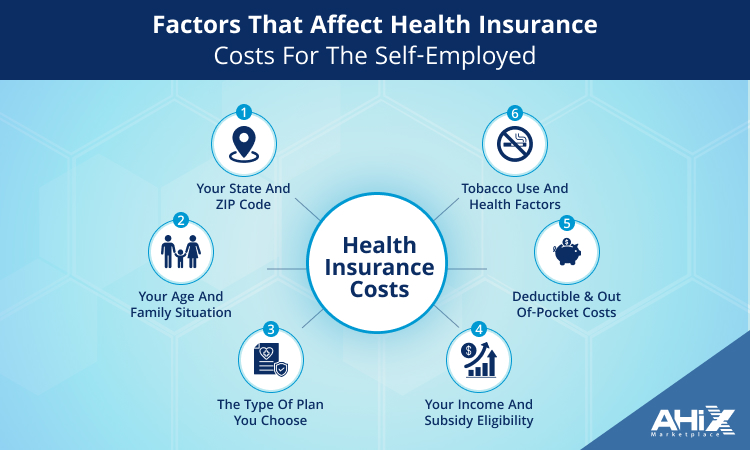
If you’ve ever wondered why health insurance premiums vary so much, you’re not alone. The truth is, there’s no single “average” price for self-employed health insurance because costs depend on a mix of personal, financial, and regional factors. Understanding these helps you compare plans wisely and avoid paying more than you need to.
1. Your State and ZIP Code
Where you live plays one of the biggest roles in determining your premium. States with higher healthcare costs or fewer insurance providers often have more expensive plans. For example, a self-employed designer in Texas might pay far less than one in Vermont or West Virginia for similar coverage.
That’s why tools like AHiX Marketplace let you compare plans by state — so you can see real, location-specific prices before you commit.
2. Your Age and Family Situation
Premiums typically rise with age because older enrollees use more medical services. If you’re 55 and self-employed, your monthly premium could be nearly double that of a 30-year-old freelancer. Adding dependents or a spouse also increases your total cost, although family plans often come with better combined pricing.
3. The Type of Plan You Choose
Every plan category, Bronze, Silver, Gold, and Platinum, balances cost and coverage differently.
- Bronze plans: Lowest monthly premiums, highest deductibles (best for healthy individuals).
- Silver plans: Moderate premiums and balanced coverage (most popular for subsidy eligibility).
- Gold/Platinum: Higher monthly cost, but much lower out-of-pocket expenses when you need care.
Choosing the right level depends on your health, income, and how often you visit doctors or need prescriptions.
4. Your Income and Subsidy Eligibility
Many self-employed workers qualify for premium tax credits through the ACA marketplace. These subsidies can dramatically reduce your monthly cost, sometimes by hundreds of dollars per month, depending on your income and household size.
Platforms like AHiX automatically calculate your subsidy eligibility, saving you time and preventing overpayment.
5. Deductible and Out-of-Pocket Costs
Your deductible, the amount you pay before insurance kicks in, affects your premium. A higher deductible usually means lower monthly payments, but more out-of-pocket costs when you use your plan. The trick is to find a balance that protects your finances without straining your monthly budget.
6. Tobacco Use and Health Factors
Most insurers charge higher premiums to tobacco users or those with certain health risks. While ACA plans can’t deny you coverage for pre-existing conditions, they can still price based on lifestyle factors like smoking.
In short, your self-employed health insurance cost depends on where you live, how much you earn, and what kind of coverage you select.
Up next, let’s explore what an average self-employed person actually pays and how you can estimate your own budget before shopping for plans.
How Much Does It Typically Cost?
When you’re comparing health insurance for self-employed individuals, a key question looms large: “What am I going to pay?” The truth is, there’s no one-size-fits-all number. But it helps to look at typical cost benchmarks so you know what a realistic range is for self-employed health insurance.
National Benchmark Figures
- For 2025, the average monthly premium for an individual on a Silver-tier marketplace plan is about $621/month.
- Broader analysis estimates the average plan cost (all tiers) at around $539/month (~$6,468/year) for a 40-year-old individual.
- These numbers apply to individual market plans and help give you ballpark expectations before factoring in your state, age, income, and coverage level.
What This Means for Self-Employed Individuals
Because you’re self-employed, you’re essentially treating the individual market as your “employer” plan, meaning you’re paying the full premium yourself. So these benchmark figures are especially relevant:
- If you’re a healthy 30- or 35-year-old living in a lower-cost state, you might pay significantly less than the $600+/month benchmark.
- If you’re older (e.g., in your 50s), living in a high-cost state, or selecting a Gold-/Platinum-level plan (for more generous benefits), you could easily pay well above that benchmark.
- And if you qualify for subsidies (due to low/variable income), your actual premium could be far below these benchmarks.
Realistic Budget Range for Self-Employed
Here’s a rough range you might use as you budget:
- Low-end (younger, healthy, Bronze plan, good subsidies): ~$200-$400/month
- Mid-range (average age, Silver plan, moderate cost state): ~$500-$700/month
- High-end (older age, Gold/Platinum plan, expensive state): $800+/month
By understanding where you fit on this spectrum, you’ll be better prepared to compare plans, negotiate your budget, and avoid being surprised when the premium arrives.
Next, we’ll explore Plan Options for the Self-Employed so you can see how different choices influence what you pay and how well you’re covered.
Plan Options for Self-Employed Individuals
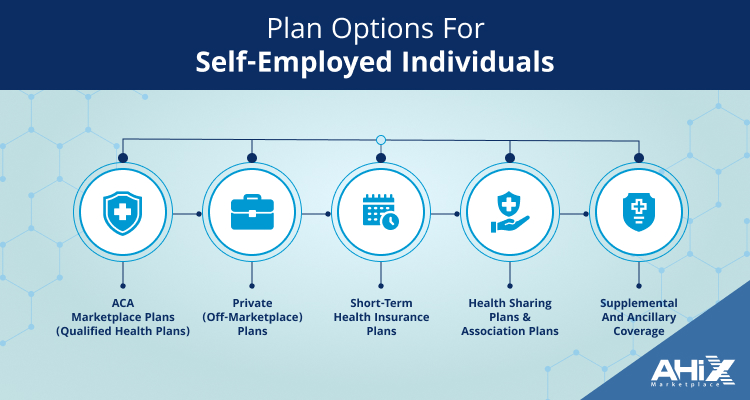
Choosing the right plan is where health insurance for self-employed professionals gets personal. You’re not just picking a price, you’re choosing how protected you’ll be if you get sick, injured, or need regular medical care. The good news? You have several strong options depending on your needs, income, and flexibility.
1. ACA Marketplace Plans (Qualified Health Plans)
These are comprehensive plans that meet all Affordable Care Act (ACA) standards covering essential benefits like hospitalization, preventive care, maternity, and prescriptions.
- Best for: Self-employed individuals who want full coverage and potential premium subsidies.
- Advantages:
- It can’t be denied for pre-existing conditions.
- Eligible for income-based tax credits and cost-sharing reductions.
- Wide variety of plans (Bronze, Silver, Gold, Platinum).
- It can’t be denied for pre-existing conditions.
- Tip: Use the AHiX Marketplace to compare ACA plans side-by-side across states and carriers. You’ll instantly see which ones qualify for subsidies based on your income.
2. Private (Off-Marketplace) Plans
These are individual or family plans sold directly by insurers. They can be identical to ACA plans in benefits, but they don’t appear on the government marketplace.
- Best for: High-income self-employed professionals who don’t qualify for subsidies or want different provider networks.
- Advantages:
- Broader coverage choices.
- Sometimes more flexible networks or add-on options (e.g., dental, vision).
- Broader coverage choices.
- Considerations:
- No premium tax credits.
- Must compare manually or through a licensed marketplace like AHiX.
- No premium tax credits.
3. Short-Term Health Insurance Plans
Short-term medical plans are designed to provide temporary coverage between jobs, during business transitions, or outside open enrollment.
- Best for: Self-employed workers needing low-cost protection for a few months.
- Advantages:
- Lower monthly premiums.
- Fast approval, flexible duration (varies by state).
- Lower monthly premiums.
- Considerations:
- Limited benefits may exclude pre-existing conditions.
- Not considered “qualified coverage” under the ACA.
- Limited benefits may exclude pre-existing conditions.
- Tip: AHiX makes it easy to filter short-term options by state, so you can see exact availability and duration rules.
4. Health Sharing Plans & Association Plans
Some freelancers and small business owners join health sharing ministries or association health plans to pool resources.
- Best for: Independent contractors who can’t afford ACA plans but want some coverage for major medical events.
- Advantages: Often cheaper monthly contributions.
- Drawbacks: Not insurance; no legal guarantee of payment; may limit what’s covered.
5. Supplemental and Ancillary Coverage
Even with good major medical insurance, consider add-on coverage to reduce risk:
- Dental plans & Vision plans (often not included in standard coverage).
- Accident or Critical Illness insurance to offset high deductibles.
- Telehealth plans for affordable virtual visits.
A balanced mix of these options can help you stay protected without overspending, especially when you compare plans effectively.
Let’s also look at how to actually compare and choose the right self-employed plan, step-by-step, so you make a confident, data-driven decision.
How to Compare & Pick the Right Plan (for Self-Employed)
Comparing health insurance for self-employed people can feel like trying to read fine print in another language. But when you know what to look for, it becomes far simpler, especially when you use a marketplace like AHiX that lays out all your options clearly, in one place.
Here’s a step-by-step process to help you choose a plan that truly fits your needs and budget.
Step 1: Define Your Health & Financial Priorities
Start by asking yourself:
- How often do I visit the doctor or need prescriptions?
- Can I afford a higher deductible if it means lower monthly payments?
- Do I want nationwide access to providers, or am I comfortable with a local network?
If you’re generally healthy and want to minimize monthly costs, a Bronze plan might work. If you prefer lower out-of-pocket costs when visiting doctors, consider Silver or Gold plans.
AHiX helps by showing the out-of-pocket maximum, deductible, and monthly premium side by side so you can see which plan balances coverage and affordability.
Step 2: Estimate Your Income for Subsidy Eligibility
Your income determines whether you qualify for premium tax credits.
If your projected annual income falls between 100% – 400% of the Federal Poverty Level (FPL), you could save hundreds of dollars a month on your premiums.
AHiX’s built-in calculator quickly estimates your eligibility, showing exactly how much your subsidy could reduce your monthly cost.
Pro Tip: Even if your income fluctuates, it’s better to estimate conservatively. If you earn less than expected, you can claim an extra tax credit later.
Step 3: Compare Key Plan Details
When reviewing your options, focus on more than just the premium. Evaluate:
- Deductible: The amount you pay before insurance coverage starts.
- Coinsurance & copays: What you pay for visits, tests, or prescriptions.
- Out-of-pocket maximum: The most you’ll spend in a year.
- Network type: HMO vs. PPO.
AHiX organizes all these details in a clean, comparable layout so you can make a side-by-side decision in minutes instead of hours.
Step 4: Verify Your Preferred Providers and Medications
Before enrolling, make sure your doctors, hospitals, and prescriptions are covered. AHiX allows you to check provider networks and pharmacy lists instantly to avoid costly surprises.
For example, a plan with a lower premium might exclude your current doctor, meaning you’d pay more out of pocket later.
Step 5: Balance Short-Term Affordability with Long-Term Protection
Many self-employed individuals focus only on monthly premiums. But that can backfire if you face a medical emergency and have to meet a high deductible.
Instead, compare total annual cost (premium + expected out-of-pocket expenses). A slightly higher premium might actually save you money overall.
Step 6: Enroll with Confidence Through AHiX
Once you’ve compared plans, AHiX lets you complete your enrollment seamlessly without navigating confusing government portals. You’ll get personalized support, state-specific guidance, and access to both ACA-qualified and short-term options.
In short: When you compare plans through AHiX, you’re not guessing you’re choosing confidently, knowing you’ve seen every option that fits your needs and budget.
Tax Implications & Financial Planning for Self-Employed Health Insurance
One of the biggest perks of being self-employed is the control you have over your business and income. But few freelancers or small-business owners realize that health insurance for self-employed individuals also comes with important tax advantages. Understanding these can help you turn a major expense into a valuable deduction and even improve your long-term financial planning.
1. The Self-Employed Health Insurance Deduction
If you’re self-employed and pay for your own coverage, you may be eligible to deduct 100 percent of your health insurance premiums from your taxable income.
- This deduction applies to medical, dental, and qualified long-term-care premiums for you, your spouse, and dependents.
- It reduces your adjusted gross income (AGI), meaning you’ll owe less in federal income tax.
- You can claim it even if you don’t itemize deductions on your tax return.
Example: If you earn $70,000 annually and spend $6,000 on self-employed health insurance, your taxable income could drop to $64,000, saving you hundreds in taxes.
2. Health Savings Accounts (HSA) and Tax-Free Growth
If you choose a high-deductible health plan (HDHP), you can open a Health Savings Account (HSA).
- Contributions are tax-deductible, grow tax-free, and can be withdrawn tax-free for qualified medical expenses.
- HSAs can act like an extra retirement account funds roll over year to year and can be invested for growth.
Many AHiX plans clearly show whether they’re HSA-eligible, making it easier to choose a tax-efficient plan.
3. Deducting Dependents and Spouse Premiums
You can also include your spouse and dependent children under your self-employed policy. Their premiums are fully deductible too, as long as they aren’t covered by an employer plan elsewhere.
This makes self-employed health insurance even more financially efficient for families turning what looks like a cost into a tax-savvy investment in your household’s wellbeing.
4. Planning Ahead for Quarterly Taxes
If you pay estimated taxes quarterly, remember to account for your health-insurance deduction. Adjusting your quarterly estimates can help you avoid overpaying or facing a large bill at year-end.
AHiX partners with certified insurance agents who can help you coordinate your plan choice with your accountant’s tax strategy ensuring your coverage decisions align with your business cash flow.
Tips to Lower Costs While Maintaining Coverage
Health insurance can feel like one of the biggest expenses when you’re self-employed. But the good news is that there are many smart ways to keep your premiums and out-of-pocket costs manageable without sacrificing quality coverage. These strategies can help you save hundreds or even thousands each year on self-employed health insurance.
1. Explore Subsidies and Tax Credits First
If your income fluctuates, you might qualify for premium tax credits that reduce your monthly payments on ACA-qualified plans.
- The amount depends on your income, household size, and state.
- Even moderate-income self-employed professionals can qualify; many are surprised to discover they’re eligible.
- On AHiX Marketplace, you can check subsidy eligibility instantly before choosing a plan.
Pro tip: If your business income varies month to month, estimate conservatively. Overestimating may cause you to miss valuable subsidies.
2. Adjust Your Plan Metal Level
Bronze, Silver, Gold, and Platinum plans each balance premiums and deductibles differently.
- Bronze plans: lowest premiums, higher deductibles, good if you rarely visit doctors.
- Silver plans: balanced coverage is often the best choice for those eligible for subsidies.
- Gold/Platinum plans: higher premiums, lower out-of-pocket costs, ideal if you expect frequent care or prescriptions.
Switching tiers can save money without giving up essential benefits.
3. Use a High-Deductible Plan with an HSA
Choosing an HSA-eligible high-deductible health plan can lower your monthly premium and allow you to save pre-tax dollars for future medical expenses. The funds grow tax-free and never expire, making this a long-term cost-saving strategy for independent workers.
4. Compare Across Carriers and States
Insurance rates vary widely by company and location. By using a licensed marketplace like AHiX, you can compare plans from leading carriers side-by-side and filter by state.
- See which insurers offer lower rates in your ZIP code.
- Identify state-specific savings or short-term plan opportunities.
- Avoid overpaying by seeing all available options, not just one insurer’s offer.
5. Don’t Over-Insure
Many self-employed people choose plans that cover more than they need, driving up premiums unnecessarily.
- If you rarely see specialists or don’t take many prescriptions, a lower-tier plan might be enough.
- Consider supplemental accident or critical-illness coverage instead of paying for a top-tier comprehensive plan you’ll rarely use.
6. Review Your Plan Every Year
Health-insurance premiums and available plans change annually. Reviewing your policy during open enrollment helps ensure you’re still getting the best deal.
AHiX can alert you when new plans or pricing options become available in your state so you never miss out on potential savings.
7. Take Advantage of Preventive Care
Even if you pick a higher-deductible plan, remember that ACA-qualified plans cover preventive services at no additional cost annual checkups, vaccines, screenings, etc. Staying proactive about your health can prevent costly treatments later.
Bottom line: Smart comparison, annual review, and tax-advantaged savings can cut your health-insurance costs dramatically. And platforms like AHiX make it effortless to find affordable, self-employed coverage without the stress of navigating multiple insurers.
When & How to Use the AHiX Marketplace

Once you understand how health insurance for self-employed professionals works, the next step is finding a reliable way to compare and enroll. That’s where AHiX Marketplace comes in as an all-in-one platform designed to make health insurance simple, transparent, and tailored to your needs.
Why Choose AHiX for Self-Employed Health Insurance?
AHiX isn’t just another quote website. It’s a licensed marketplace that helps you:
- Compare multiple plans from top national and regional carriers in one place.
- See real prices for your age, income, and state.
- Check subsidy eligibility instantly, so you don’t overpay.
- Explore both ACA-qualified and short-term options, all filtered by your preferences.
Whether you’re a freelancer, independent contractor, or small business owner, AHiX gives you full visibility into your health insurance options without any confusion or hidden fees.
How the Process Works (Step-by-Step)
1. Enter your details
Provide your state, age, family size, and estimated income.
2. View plans instantly
See ACA-qualified, off-marketplace, and short-term plans — all in one comparison dashboard.
3.Check subsidy eligibility
AHiX automatically calculates any tax credits or discounts you might qualify for.
4.Compare benefits side-by-side
Review premiums, deductibles, out-of-pocket limits, and networks in an easy-to-read layout.
5.Get expert help when needed
Licensed agents are available to guide you through plan details or enrollment questions.
6.Enroll securely online
Complete your application directly through the AHiX platform with full compliance and security.
What Makes AHiX Different
- Personalized experience: Plans tailored to your income, goals, and state regulations.
- Clarity over complexity: Every plan displayed clearly, no jargon, no hidden terms.
- Speed: Compare and enroll in under 10 minutes.
- Support: Real people to assist you via chat or phone if you need help understanding your coverage.
AHiX Marketplace simplifies health insurance for self-employed individuals, giving you control, confidence, and coverage that fits your budget.
Conclusion: Take Control of Your Coverage and Your Costs
Finding the right health insurance for self-employed professionals doesn’t have to be stressful, confusing, or expensive. Once you understand how premiums are determined, what plan types exist, and how to use tax benefits strategically, you gain complete control over your coverage just like you do over your business.
The most important thing to remember is that you have options. Whether you prefer an ACA-qualified plan with robust coverage, a short-term plan to bridge gaps, or a tailored private option, the key is comparing all of them in one place confidently and transparently. That’s exactly what AHiX Marketplace helps you do.
With AHiX, you can:
- Instantly compare self-employed health insurance plans by state, carrier, and price.
- Discover how much you could save with tax credits or subsidies.
- Find plans that fit your income, lifestyle, and long-term goals.
- Get help from licensed professionals, not automated bots, whenever you need it.
Your Next Step
Don’t wait for another open enrollment cycle or an unexpected medical bill to take action.
Use AHiX Marketplace today to:
- Check your eligibility for savings and subsidies.
- Compare top self-employed health insurance plans side by side.
- Enroll confidently in a plan that protects your health and your business.
The right coverage isn’t just about staying insured. It’s about protecting your independence, your income, and your peace of mind.
👉 Start comparing plans now at AHiX Marketplace and find the best self-employed health insurance for your needs today.
FAQs
1. What is self-employed health insurance, and how does it work?
If you run your own business or freelance full-time, you’re considered self-employed. That means you need to buy your own health coverage instead of getting it through an employer. You can choose from ACA marketplace plans, private plans, or short-term medical coverage, depending on your income and state. Marketplaces like AHiX help you compare these options in one place and find affordable plans that match your needs.
2. How much does health insurance cost for self-employed people?
The average self-employed health insurance premium ranges from $450 to $700 per month for individual coverage, depending on your age, state, and plan type. Bronze plans have the lowest premiums but higher deductibles, while Gold or Platinum plans offer broader coverage at higher monthly costs. With AHiX, you can view real prices for your ZIP code and income level before enrolling.
3. Can self-employed individuals qualify for subsidies or tax credits?
Yes. If your income is between 100% and 400% of the federal poverty level, you likely qualify for premium tax credits that reduce your monthly premium. Even many middle-income freelancers and consultants are eligible. You can check your exact subsidy amount instantly on AHiX Marketplace.
4. Are health insurance premiums tax-deductible for self-employed workers?
Absolutely. The IRS allows self-employed individuals to deduct up to 100% of their health, dental, and qualified long-term-care premiums from taxable income. This deduction lowers your overall tax bill even if you don’t itemize deductions. It’s one of the best financial benefits of being self-employed.
5. What’s the best type of health insurance for freelancers or small business owners?
It depends on your needs:
- ACA Marketplace plans – full coverage, ideal if you qualify for subsidies.
- Private plans – more flexibility if you earn above subsidy limits.
- Short-term plans – budget-friendly, temporary protection for transitions or new businesses.
AHiX Marketplace makes it easy to compare all three side-by-side and pick what fits your lifestyle.
6. Can I get health insurance if my income changes during the year?
Yes. Self-employed income often fluctuates, and the ACA accounts for that. If your income changes, you can update it through the marketplace, and your subsidy amount will adjust automatically. AHiX helps you recalculate this anytime so you never overpay.
7. How can I find affordable self-employed health insurance quickly?
The easiest way is to use an online comparison tool like AHiX. You simply enter your state, age, and income, and the system shows real-time quotes from trusted carriers. It takes just a few minutes to see plans that fit your coverage needs and budget.
8. What’s the difference between ACA and short-term plans for self-employed people?
- ACA plans cover all essential health benefits, pre-existing conditions, and preventive care.
- Short-term plans cost less but have limited coverage and are best for short gaps between major policies.
AHiX clearly labels both options so you know exactly what type of protection you’re choosing.
9. Can self-employed people use a Health Savings Account (HSA)?
Yes, if you select a High-Deductible Health Plan (HDHP), you can open an HSA to save pre-tax money for medical expenses. Your contributions are tax-deductible, and funds roll over every year. Many plans available on AHiX show whether they’re HSA-eligible right on the comparison page.
10. How do I sign up for self-employed health insurance?
You can enroll online through AHiX Marketplace in just a few minutes.
- Enter your details (age, state, income).
- Compare ACA, private, and short-term plans.
- Check subsidy eligibility automatically.
- Enroll securely with expert help if needed.