
A hospital stay can create expenses that continue even after your primary health plan pays its share. You may still be responsible for a deductible, copays, coinsurance, transportation, childcare, and lost income during recovery.
This is where hospital indemnity insurance may help. It provides a predetermined cash benefit when a covered hospital event occurs. However, it is not automatically valuable for everyone.
So, is hospital indemnity insurance worth it? It may be worth considering when your existing plan leaves substantial hospital cost sharing and an unexpected admission would strain your savings. It may offer less value when you already have strong hospital benefits, adequate emergency savings or overlapping supplemental coverage.
This guide explains how hospital indemnity insurance works, what it may cover, how much it can cost and what to review before enrolling.
Important: Hospital indemnity insurance provides limited, fixed cash benefits. It is supplemental coverage and does not replace comprehensive major medical insurance.
What Is Hospital Indemnity Insurance?
Hospital indemnity insurance is a form of fixed indemnity coverage that pays a predetermined cash benefit after a covered hospital event.
Depending on the policy, a covered event could include:
- Admission to a hospital
- Each day of hospital confinement
- Intensive care confinement
- Inpatient surgery
- Certain observation stays
- Newborn or maternity benefits
The payment is based on the policy’s schedule of benefits, not the amount charged by the hospital.
For example, a plan might provide a single fixed benefit for a covered admission and a separate daily amount for each covered hospital day. The payment may be smaller or larger than your actual out-of-pocket expenses.
Federal guidance explains that qualifying fixed indemnity coverage does not provide comprehensive health insurance. It generally pays a fixed cash amount following a covered event, regardless of the healthcare expenses the policyholder actually incurs.
Before considering supplemental protection, make sure you have suitable primary coverage. AHiX allows consumers to explore individual health insurance plans and compare major medical options before deciding whether an additional policy is appropriate.
How Does Hospital Indemnity Insurance Work?
Hospital indemnity coverage operates differently from a standard health insurance plan.
With major medical insurance, the insurer generally pays healthcare providers according to the plan’s network, deductible, copay and coinsurance rules. Hospital indemnity insurance usually pays a fixed benefit after a qualifying event.
The general process is:
- You pay a premium to keep the policy active.
- You experience a hospital event covered by the policy.
- You submit the required claim documents.
- The insurer reviews the claim and verifies eligibility.
- The approved fixed benefit is paid according to the policy terms.
Traditionally, fixed indemnity benefits are paid directly to the policyholder rather than to the medical provider. The policyholder may then use the money for medical or nonmedical expenses, depending on the policy.
The payment is not based on your hospital bill
Suppose your policy promises a $1,000 admission benefit. If your covered admission qualifies, the policy may pay $1,000 whether your remaining medical responsibility is $500 or $5,000.
This creates both an advantage and a limitation.
The advantage is predictability. You know the benefit amount in advance.
The limitation is that the benefit is not designed to pay your entire hospital bill. A large deductible or extended hospital stay could cost considerably more than the policy pays.
What Does Hospital Indemnity Insurance Cover?
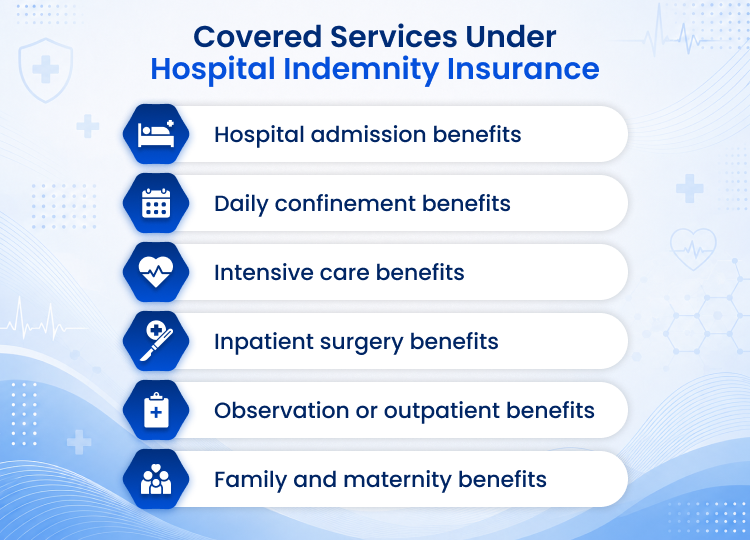
Coverage differs by insurer, state, and policy. The exact schedule of benefits determines which events qualify and how much the plan pays.
Potential benefits may include:
Hospital admission benefits
Some policies provide a one time payment when a covered person is formally admitted to a hospital.
Daily confinement benefits
A plan may pay a fixed amount for each covered day of hospital confinement, subject to a maximum number of days.
Intensive care benefits
Some policies provide a higher daily payment for qualifying intensive care confinement.
Inpatient surgery benefits
Certain plans include a fixed payment for eligible inpatient procedures.
Observation or outpatient benefits
Some policies may include benefits for observation stays, emergency services or specified outpatient procedures. These benefits should not be assumed because they are not included in every plan.
Family and maternity benefits
Coverage for a spouse, dependent child, childbirth or newborn care may be available under certain policies or optional riders. Waiting periods and eligibility rules may apply.
Always review the certificate of coverage and schedule of benefits. Marketing summaries may not show every limitation, exclusion or benefit maximum.
What Hospital Indemnity Insurance Usually Does Not Replace
Hospital indemnity insurance is not designed to provide comprehensive coverage for all healthcare services.
It generally should not be relied on as the primary way to pay for:
- Routine doctor visits
- Preventive screenings
- Ongoing prescription medications
- Specialist care
- Chronic condition management
- Outpatient treatment
- The full cost of hospitalization
- All essential health benefits
ACA qualified plans are required to cover categories of essential health benefits, including hospitalization, emergency care, prescription medication, maternity care, preventive services and mental health treatment. Hospital indemnity coverage does not operate under the same comprehensive benefit structure.
Consumers who need comprehensive coverage can review qualified health plans before adding a supplemental policy.
How Much Does Hospital Indemnity Insurance Cost?
There is no single national price for hospital indemnity insurance. Premiums depend on the applicant, insurer, state, and selected benefit structure.
Factors that may affect the cost include:
| Cost factor | How it may affect the premium |
| Age | Rates may vary by the covered person’s age |
| Benefit amount | Higher admission or daily benefits may cost more |
| Individual or family coverage | Covering dependents can increase the premium |
| Location | Availability and rates vary by state |
| Optional benefits | Additional riders may increase the cost |
| Underwriting | Some policies may ask health questions |
| Policy term | Renewal provisions may affect long-term cost |
Do not evaluate a plan based only on its monthly premium. A low-cost policy may provide a small benefit, have a narrow definition of admission or apply significant waiting periods.
Compare the annual premium with:
- The admission benefit
- Daily confinement payment
- Maximum covered days
- Intensive care benefit
- Waiting periods
- Exclusions
- Renewal terms
- Maximum annual benefit
An AHiX licensed advisor can help you compare supplemental coverage with your primary plan, but the policy documents should remain the final source for determining what is covered.
Example of How Hospital Indemnity Benefits May Be Paid
The following is a hypothetical example only. It is not an actual quote or description of a specific policy.
Assume a plan provides:
- A $1,000 covered hospital admission benefit
- A $200 daily confinement benefit
- Daily payments for up to ten covered days
If the policyholder has a qualifying three-day hospital stay, the calculation could look like this:
| Benefit | Calculation | Hypothetical payment |
| Admission benefit | Fixed amount | $1,000 |
| Daily confinement benefit | $200 × 3 days | $600 |
| Total benefit | – | $1,600 |
The policyholder’s actual hospital bill does not determine this payment. The benefit is based on the fixed amounts stated in the contract.
A real policy could use different benefit amounts, admission definitions, maximums, or exclusions.
Benefits of Hospital Indemnity Insurance
Hospital indemnity coverage may provide several practical benefits when it matches a genuine gap in your primary coverage.
Direct cash support
The benefit is traditionally paid to the policyholder. This gives you flexibility to use the payment for eligible needs rather than limiting it to a specific provider bill.
Help with out-of-pocket medical costs
The payment may help with a deductible, copay, coinsurance or other costs left by your major medical plan.
Support for nonmedical expenses
A hospital stay may create expenses that health insurance does not address, including childcare, transportation, meals and household bills. A fixed cash payment may help manage these costs.
Predictable benefit amounts
The policy identifies its fixed benefits in advance. This can make it easier to understand what the plan may pay after a covered event.
Additional protection for high deductible plan members
Someone enrolled in a high deductible health plan may have significant financial responsibility before the primary policy pays much of the cost. Hospital indemnity coverage could provide an additional cushion, although the potential benefit should be compared carefully with the premium.
Limitations of Hospital Indemnity Insurance
The same features that make hospital indemnity insurance simple also create important limitations.
Fixed payments may not cover the full expense
A hospital bill or primary plan cost sharing can exceed the indemnity benefit. The policy does not automatically pay the remaining balance.
It is not comprehensive health insurance
Federal rules classify qualifying hospital and fixed indemnity products as excepted benefits. They are not required to include many of the protections that apply to comprehensive health coverage.
A hospital event must meet the policy definition
A visit to an emergency room does not necessarily count as a hospital admission. An observation stay may also be treated differently from inpatient confinement.
Read how the policy defines:
- Admission
- Confinement
- Hospital
- Intensive care
- Covered illness
- Covered injury
Waiting periods may apply
Some policies apply waiting periods to particular benefits, diagnoses or pre-existing conditions. The applicable period varies by policy and carrier.
Exclusions can reduce the value
Policies may exclude or limit benefits for certain procedures, conditions, treatments or circumstances. Do not assume that maternity care, mental health treatment, substance use treatment or outpatient surgery is included.
Benefit caps may apply
A policy may limit:
- The number of payable hospital days
- The number of admissions per year
- The total annual benefit
- Intensive care benefits
- Benefits for the same condition
Coverage may overlap with other policies
Accident, critical illness, disability or other supplemental coverage may already address part of the same financial risk. Paying for several overlapping policies can reduce the value of adding another premium.
Hospital Indemnity Insurance vs Other Coverage
| Coverage | Main purpose | How benefits are generally paid | Replaces major medical insurance? |
| Major medical insurance | Covers a broad range of eligible healthcare services | Pays according to plan benefits, provider charges, and cost sharing | Yes, it serves as primary coverage |
| Hospital indemnity insurance | Provides cash after covered hospital events | Fixed amount based on the benefit schedule | No |
| Critical illness insurance | Provides support after diagnosis of a listed serious illness | Often a fixed lump sum or scheduled benefit | No |
| Accident insurance | Provides benefits after specified accidental injuries or treatments | Fixed amount based on the covered event | No |
| Short-term disability insurance | Replaces part of lost income when a covered condition prevents work | Periodic income benefit | No |
AHiX’s 2026 health plan grid can help you understand how comprehensive, non-ACA, employer and government coverage categories differ before comparing supplemental products.
Hospital Indemnity Insurance vs Critical Illness Insurance
Hospital indemnity insurance generally focuses on a covered hospital admission or confinement. Critical illness insurance generally focuses on the diagnosis of an illness listed in the policy.
For example, a critical illness policy may provide a benefit after a covered cancer, stroke or heart attack diagnosis. Hospital indemnity coverage may pay because the policyholder was admitted to a hospital, regardless of whether the diagnosis appears on a critical illness list.
The products can overlap when a covered illness also causes hospitalization. Review both benefit schedules before carrying both policies.
Hospital Indemnity Insurance vs Accident Insurance

Accident insurance generally pays benefits related to covered accidental injuries, such as fractures, dislocations, emergency treatment, or ambulance services.
Hospital indemnity coverage is triggered by qualifying hospital events and may apply to covered illnesses as well as injuries.
Someone concerned mainly about sports injuries or accidental events may find accident coverage more relevant. Someone primarily concerned about the financial effects of any covered hospital admission may prefer hospital indemnity coverage.
The right comparison depends on the actual policy terms, not only the product name.
Who May Benefit From Hospital Indemnity Insurance?
Hospital indemnity insurance may be worth considering when:
- Your primary plan has a high deductible or significant hospital coinsurance.
- Your savings would not comfortably cover an unexpected admission.
- You have limited paid leave or variable income.
- A hospital stay would create childcare or transportation expenses.
- Your current policy leaves a clear financial gap that the indemnity benefit could address.
- You understand the exclusions and the possible payment is meaningful compared with the premium.
People with variable income may also benefit from reviewing AHiX resources on health insurance for self employed and 1099 workers or part time employee health insurance.
Who May Not Need It?
Hospital indemnity coverage may provide limited value when:
- Your major medical plan has low hospital cost sharing.
- You have enough emergency savings to manage the likely expense.
- The policy benefit is small compared with its annual premium.
- Serious situations are excluded.
- You already carry overlapping supplemental coverage.
- Your budget would be better used to maintain comprehensive coverage or build savings.
- The plan has restrictive admission definitions or benefit caps.
Being healthy does not guarantee that hospitalization will never occur. However, purchasing supplemental insurance solely because an event is possible is not enough. The policy should address a meaningful financial risk.
How to Decide If Hospital Indemnity Insurance Is Worth It
Use the following questions before enrolling:
- What would I owe after a hospital stay under my primary plan?
- What is my deductible, coinsurance, and out-of-pocket maximum?
- How much could I pay from savings without financial hardship?
- What benefit would the indemnity policy provide for a typical admission?
- How much would I pay in premiums each year?
- Are observation stays covered?
- Are there waiting periods or pre-existing condition limitations?
- Are maternity, mental health or substance use admissions covered?
- How many hospital days can generate a payment?
- Do I already have accident, critical illness or disability coverage?
- Is the policy individual or tied to employment?
- What happens if I move, change jobs, or renew the policy?
A useful comparison is the annual premium against a realistic payout under the circumstances you are trying to protect against.
How to Compare Hospital Indemnity Plans
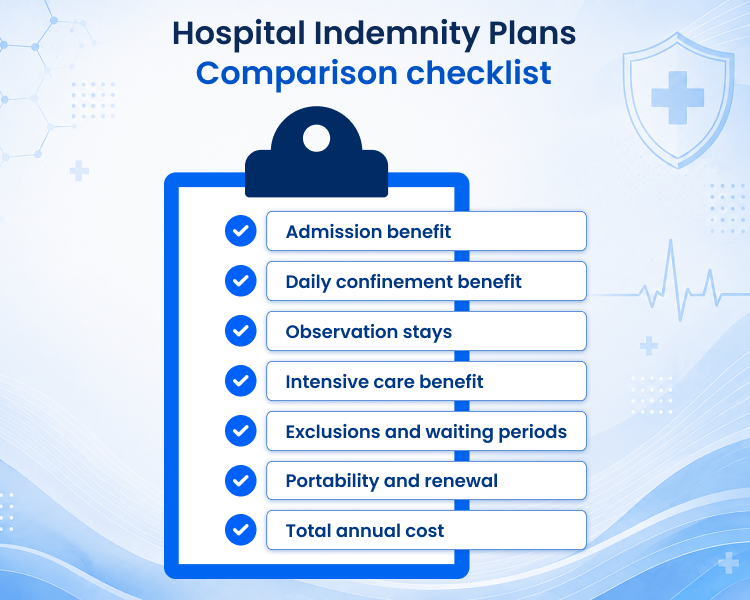
Do not choose a plan based only on the advertised daily benefit. Compare the full policy structure.
Pay particular attention to:
Admission benefit
Check whether the plan provides a one-time admission payment and how it defines a qualifying admission.
Daily confinement benefit
Review the daily amount, when payments begin, and the maximum number of payable days.
Observation stays
An observation stay may not meet the policy’s definition of inpatient admission. Check whether it receives a separate benefit.
Intensive care benefit
Confirm whether the intensive care payment replaces or supplements the standard daily benefit.
Exclusions and waiting periods
Review the policy’s treatment of pre-existing conditions, maternity, mental health services, elective procedures and other restricted situations.
Portability and renewal
Individual coverage is generally separate from employment. Employer-sponsored coverage may end when employment ends unless the policy offers a portability or conversion option.
Total annual cost
Compare the annual premium with the maximum benefit you could realistically receive.
Consumers still selecting their main coverage can compare non-qualified health plans and comprehensive individual options through AHiX before deciding whether supplemental protection fits their needs.
Is Hospital Indemnity Insurance Worth It? Final Verdict
Hospital indemnity insurance may be worth it when your primary coverage leaves substantial hospital cost sharing and a covered admission would place pressure on your savings or household income.
It may not be worth the added premium when your primary plan already provides strong hospital protection, you have sufficient emergency savings or the policy offers limited benefits with broad exclusions.
The decision should be based on four numbers:
- Your current hospital cost sharing
- Your available emergency savings
- The policy’s annual premium
- The benefit it would pay for a realistic hospital stay
Hospital indemnity insurance can provide helpful financial support, but it should be treated as a supplement to comprehensive coverage, not as a substitute for it.
Frequently Asked Questions
1. Is hospital indemnity insurance worth it if I already have health insurance?
It may be worth considering when your existing health plan has a high deductible, substantial hospital coinsurance or other cost sharing that would strain your finances. Compare the policy’s annual premium and fixed benefit with the financial gap left by your primary plan.
2. What does hospital indemnity insurance cover?
Coverage may include fixed benefits for hospital admission, daily confinement, intensive care and other services listed in the policy. Benefits, exclusions, waiting periods and maximums vary by carrier and plan, so review the schedule of benefits before enrolling.
3. Does hospital indemnity insurance pay the entire hospital bill?
No. The policy pays a predetermined amount based on covered events. It does not calculate its payment from the actual hospital charge and may pay considerably less than your total medical responsibility.
4. Who receives the hospital indemnity payment?
Benefits are traditionally paid directly to the policyholder rather than the hospital. The policyholder can generally decide how to use the cash, subject to the contract’s terms.
5. Can hospital indemnity benefits be used for nonmedical expenses?
Generally, yes. Because the benefit is usually paid directly to the policyholder, it may be used for expenses such as transportation, childcare, housing, or lost income. Confirm the terms of the specific policy.
6. Does hospital indemnity insurance cover pre-existing conditions?
It depends on the policy. Some plans may exclude a pre-existing condition, apply a waiting period, or limit related benefits. Review the policy definition and exclusion period rather than assuming the condition will be covered.
7. Is hospital indemnity insurance the same as fixed indemnity insurance?
Hospital indemnity insurance is a type of fixed indemnity coverage focused mainly on hospital-related events. Other fixed indemnity products may provide scheduled benefits for different medical services or specified events.
8. Does an emergency room visit qualify for hospital indemnity benefits?
Not automatically. An emergency room visit may not qualify unless the policy includes an emergency benefit or the visit results in a covered admission. Check how the policy defines hospital admission, observation, and emergency treatment.
9. Is hospital indemnity insurance worth it with a high deductible plan?
It may be useful when the benefit would meaningfully offset your deductible or other hospital cost sharing. However, compare the annual premium, benefit limit, waiting periods, and exclusions before deciding.
10. What should I check before buying hospital indemnity insurance?
Review the admission benefit, daily payment, covered days, observation rules, exclusions, waiting periods, pre-existing condition provisions, portability, renewal terms, and total annual premium. Also confirm that you already have appropriate comprehensive health coverage.