
Health care costs keep climbing, and 2026 is no exception. If you get coverage through work, buy it on your own, or run a business trying to offer competitive benefits, understanding commercial health insurance has never mattered more. This guide breaks down what commercial health insurance actually is, the plan types available, what they cost this year, what they cover, and how to choose the right one.
What Is Commercial Health Insurance?
Commercial health insurance is private health coverage sold by for-profit or nonprofit insurance companies rather than provided by the government. It’s typically offered through an employer (group coverage), purchased individually on the private market, or bought through the ACA Health Insurance Marketplace.
Unlike public programs such as Medicare or Medicaid, commercial health insurance plans are priced and designed by private insurers, such as UnitedHealthcare, Aetna, Cigna, Blue Cross Blue Shield, or Elevance Health, and regulated at both the federal and state level. In 2026, commercial health insurance plans remain the primary source of coverage for most working-age Americans and their families.
Types of Commercial Health Insurance Plans in 2026
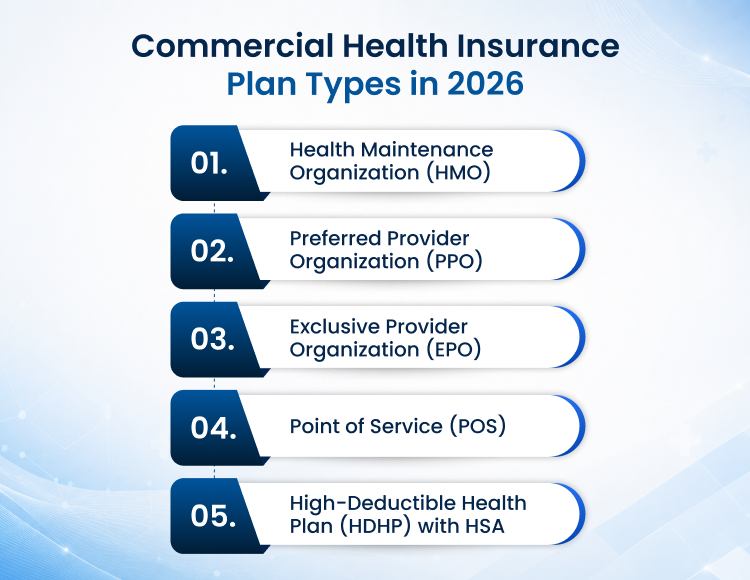
Not all commercial health insurance plans work the same way. The type of plan you choose affects your provider network, referral requirements, and out-of-pocket costs. Here are the main types of commercial health insurance available this year:
1. Health Maintenance Organization (HMO)
HMO plans require you to choose a primary care physician (PCP) and get referrals to see specialists. Care is generally limited to an in-network provider list. HMOs tend to have lower premiums and lower out-of-pocket costs, making them a popular choice for budget-conscious individuals and families.
2. Preferred Provider Organization (PPO)
PPO plans offer more flexibility; you can see specialists without a referral and use out-of-network providers, though at a higher cost. In the ongoing HMO vs PPO debate, PPOs generally win on flexibility but lose on price, with higher premiums and deductibles than HMOs.
3. Exclusive Provider Organization (EPO)
EPOs blend HMO and PPO features: no referrals are needed, but coverage is restricted to an in-network panel of providers except in emergencies. EPOs often cost less than PPOs while still offering direct specialist access.
4. Point of Service (POS)
POS plans require a PCP referral like an HMO but allow out-of-network care like a PPO, usually at a higher cost. This hybrid structure appeals to people who want some flexibility without paying full PPO premiums.
5. High-Deductible Health Plan (HDHP) with HSA
HDHPs carry lower monthly premiums paired with higher deductibles. Many are HSA-eligible, meaning you can contribute pre-tax dollars to a Health Savings Account to cover qualified medical expenses. These plans have grown steadily more popular among both employers and individuals looking to manage rising premium costs.
6. Indemnity (Fee-for-Service) Plans
Indemnity plans let you see any doctor or hospital without network restrictions. The insurer reimburses a set percentage of costs after you pay upfront. These plans are less common today but still available, largely because of their unmatched provider flexibility.
How Commercial Health Insurance Works
Commercial health insurance operates on a shared-cost model between you, your employer (if applicable), and the insurer:
- Premium – the amount paid monthly (or per pay period) to keep the plan active.
- Deductible – what you pay out of pocket before the insurer starts covering costs.
- Copay – a fixed fee for a specific service, like $30 for a doctor visit.
- Coinsurance – your percentage share of costs after the deductible is met (e.g., 20%).
- Out-of-pocket maximum – the cap on what you’ll pay in a plan year, after which the insurer covers 100% of eligible costs.
Understanding these terms is essential to comparing commercial health insurance plans accurately, since a low premium can often mean a much higher deductible or coinsurance share.
Commercial Health Insurance Costs in 2026
Cost is usually the deciding factor when comparing commercial health insurance plans, and 2026 has brought continued increases across the board.
- Employer-sponsored coverage: According to KFF’s Employer Health Benefits Survey, average annual premiums for employer-sponsored health insurance reached roughly $9,325 for single coverage and $26,993 for family coverage in 2025, with premiums continuing to climb by an estimated 6–8% into 2026. Employees typically shoulder about $114/month for single coverage and $525/month for family coverage, while employers cover the bulk of the remaining premium often 70–80% of the single-coverage cost.
- ACA Marketplace plans: For people buying commercial health insurance coverage on their own through the Marketplace, the average benchmark Silver plan runs around $497/month for a 40-year-old without subsidies. With premium tax credits, many enrollees pay closer to $66/month, depending on income.
- Cost drivers in 2026: Rising prescription drug costs (including GLP-1 weight-loss medications), specialty care utilization, hospital pricing, and general medical inflation are the biggest forces pushing commercial health insurance costs higher this year.
Because commercial health insurance costs vary significantly by plan type, state, insurer, age, and household size, getting a personalized quote is the only reliable way to know what you’ll actually pay.
What Does Commercial Health Insurance Cover?
Most commercial health insurance plans sold today, especially those compliant with ACA regulations, must cover a core set of essential health benefits, including:
- Preventive and wellness visits (often at no cost to you)
- Emergency services and hospitalization
- Maternity and newborn care
- Mental health and substance use disorder services
- Prescription drug coverage
- Laboratory services and diagnostic imaging
- Chronic disease management
- Pediatric services, including dental and vision for children
Beyond these essentials, commercial health insurance coverage can vary widely some plans include adult dental/vision, telehealth, fertility treatment, or expanded behavioral health benefits. In contrast, others charge extra or exclude them entirely. Always review the plan’s Summary of Benefits and Coverage (SBC) before enrolling.
Commercial Health Insurance vs. Government Health Insurance
| Feature | Commercial Health Insurance | Government Health Insurance (Medicare/Medicaid) |
| Provider | Private insurers (Aetna, Cigna, BCBS, etc.) | Federal/state government |
| Eligibility | Open to employees, individuals, families | Age-, income-, or disability-based |
| Cost | Varies by plan, employer contribution, subsidies | Often lower or no premium (Medicaid); standardized premiums (Medicare) |
| Plan Variety | HMO, PPO, EPO, POS, HDHP, Indemnity | Limited to program-specific plan structures |
| Customization | High: plans vary by employer/insurer | Lower benefits are largely standardized |
How to Choose the Right Commercial Health Insurance Plan in 2026
- Estimate your annual healthcare usage; frequent doctor visits or chronic conditions may justify a higher-premium, lower-deductible plan.
- Compare total cost, not just premium; factor in deductibles, copays, coinsurance, and the out-of-pocket maximum.
- Check the provider network to confirm your preferred doctors and hospitals are in-network.
- Review prescription drug coverage, especially important if you take regular medications.
- Consider an HSA-eligible HDHP if you’re healthy and want tax-advantaged savings.
- Look at extra benefits: telehealth, mental health support, and wellness programs add real value.
- Read the Summary of Benefits and Coverage (SBC) before enrolling to avoid coverage surprises.
Commercial Health Insurance Trends to Watch in 2026
- Rising premiums, driven largely by prescription drug spending and specialty care costs.
- Expanded telehealth and virtual-first plan options as insurers look to control costs while maintaining access.
- Greater HDHP/HSA adoption as both employers and individuals try to offset rising premiums.
- AI-driven care navigation and claims processing, improving how quickly members get answers and approvals.
- Continued scrutiny of GLP-1 and weight-loss drug coverage, a major cost driver insurers and employers are actively managing.
Final Thoughts
Commercial health insurance in 2026 offers more plan variety than ever, from budget-friendly HMOs to flexible PPOs and tax-advantaged HDHPs, but costs are rising across nearly every category. The right commercial health insurance plan for you depends on your health needs, budget, and how much flexibility you need in choosing providers. Comparing plans side by side, understanding the true cost structure, and checking coverage details carefully will help you make a confident, informed decision this year.
Frequently Asked Questions (FAQs)
1. What is commercial health insurance?
Commercial health insurance is private health coverage sold by insurance companies through an employer, purchased individually, or bought via the ACA Marketplace as opposed to government programs like Medicare or Medicaid.
2. What are the main types of commercial health insurance plans?
The main types are HMO, PPO, EPO, POS, High-Deductible Health Plans (HDHP), and Indemnity (fee-for-service) plans. Each differs in network rules, referral requirements, and cost structure.
3. How much does commercial health insurance cost in 2026?
Employer-sponsored premiums average around $9,325/year for single coverage and $26,993/year for family coverage, with employees typically paying a portion of that. ACA Marketplace plans average about $497/month for a benchmark Silver plan before subsidies, or as low as $66/month with subsidies.
4. Is commercial health insurance better than government health insurance?
Neither is universally “better.” Commercial health insurance generally offers more plan variety and customization, while government insurance (Medicare/Medicaid) often has lower or no premiums for eligible individuals. The right choice depends on eligibility, budget, and health needs.
5. What’s the difference between an HMO and a PPO?
HMOs require a primary care physician and specialist referrals, with lower costs but less flexibility. PPOs allow you to see specialists and out-of-network providers without a referral, but at a higher premium and deductible.
6. Does commercial health insurance cover pre-existing conditions?
Yes. Under the Affordable Care Act, ACA-compliant commercial health insurance plans cannot deny coverage or charge more due to pre-existing conditions.
7. Can I get commercial health insurance without an employer?
Yes. You can buy an individual commercial health insurance plan directly from an insurer or through the ACA Health Insurance Marketplace, where you may also qualify for income-based premium subsidies.
8. What is a high-deductible health plan (HDHP), and is it worth it?
An HDHP has a lower monthly premium but a higher deductible, and is often paired with a Health Savings Account (HSA) for tax-advantaged savings. It can be a good fit for generally healthy individuals who want to save on premiums and build HSA funds.
9. What does commercial health insurance typically cover?
Most plans cover preventive care, emergency services, hospitalization, maternity care, mental health and substance use treatment, prescription drugs, and pediatric services, along with other essential health benefits required under the ACA.
10. How do I choose the best commercial health insurance plan for 2026?
Compare total costs (not just premiums), confirm your doctors and hospitals are in-network, review prescription drug coverage, consider your expected healthcare usage, and check for added benefits like telehealth or wellness programs before enrolling.