
A Smarter Way to Offer Health Coverage
Rising health insurance costs have made it difficult for small and mid-sized businesses to offer employee benefits. Traditional group health plans often come with yearly premium hikes, rigid structures, and limited choices, leaving both employers and employees frustrated.
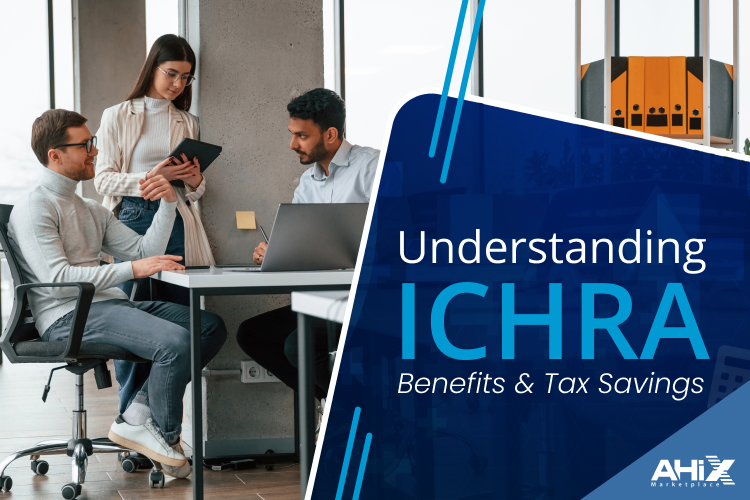
That’s why many businesses are now turning to Individual Coverage Health Reimbursement Arrangements (ICHRAs), a modern, tax-advantaged way to provide flexible health benefits.
Instead of choosing one group plan for everyone, employers set a monthly allowance, and employees use that allowance to buy individual health insurance plans that suit their personal and family needs.
Since its introduction in 2020, the ICHRA model has rapidly grown in popularity across the U.S., offering cost control for employers and greater choice for employees.
Explore ACA-qualified, ICHRA-compatible plans in your state, all in one place at AHiX Marketplace.
What Is an Individual Coverage HRA (ICHRA)?
An Individual Coverage Health Reimbursement Arrangement, or ICHRA, is an employer-funded benefit that reimburses employees for their individual health insurance premiums and eligible medical expenses tax-free.
With an ICHRA:
- The employer decides how much to contribute each month.
- The employee uses that allowance to purchase a personal, ACA-compliant health insurance plan from the Marketplace or through a platform like AHiX.
- The employee submits proof of payment and receives reimbursement for eligible expenses.
Unlike traditional group health insurance, where the company chooses a single plan for everyone, ICHRA gives each employee the freedom to:
- Pick their own coverage and doctors.
- Keep their plan if they change jobs.
- Enjoy tax-free reimbursements for health costs.
In short, employers control the budget, and employees control their coverage.
Now that you know what an ICHRA is, let’s look at how it actually works in practice.
How Does ICHRA Work? (Step-by-Step Guide)
An ICHRA (Individual Coverage Health Reimbursement Arrangement) is simple in concept, but it works best when you understand each step clearly.
Here’s how the process flows from setup to reimbursement:
Step 1: Employer Designs the ICHRA Plan
Every ICHRA starts with the employer.
The employer decides:
- Who’s eligible (e.g., full-time, part-time, seasonal, remote, or salaried employees).
- How much allowance is given to each class of employees?
- Which expenses are eligible for reimbursement premiums only, or premiums plus other qualified medical expenses under IRS Publication 502?
Employers can vary the allowance across employee groups (called “classes”) but must keep the same rules for everyone in that class.
This flexibility allows companies to tailor benefits to their workforce while keeping control over costs.
Step 2: Employees Buy Individual Health Insurance
Once the ICHRA plan is set, employees purchase their own health insurance.
They can shop through:
- The federal or state Marketplace, or
- AHiX Marketplace, which simplifies comparison of ACA-compliant plans by price, coverage, and network.
The key rule:
Employees must choose a plan that meets Minimum Essential Coverage (MEC), meaning it includes preventive care, hospitalization, maternity, mental health, and prescription benefits.
Each employee owns their policy, which means:
- Their coverage stays with them even if they switch jobs.
- They can choose the insurer, doctors, and hospitals they prefer.
Explore ACA-qualified, ICHRA-ready plans easily on AHiX Marketplace, compare prices, check networks, and find the right fit for your allowance.
Step 3: Employees Submit Proof of Expenses
After purchasing coverage, employees submit proof of their insurance premium payments or other approved expenses.
Typically, this includes:
- Receipts or premium invoices from the insurance carrier
- Documentation showing the date, amount, and coverage details
Employers (or a third-party administrator, TPA) review the submissions to ensure they meet ICHRA requirements.
Step 4: Employer Reviews & Reimburses Tax-Free
Once the documentation is verified, the employer reimburses employees up to their monthly allowance.
Reimbursements are typically:
- Tax-free for employees
- Tax-deductible for employers
- Processed through payroll or direct deposit
Employees can continue this cycle each month, ensuring consistent, flexible coverage while employers maintain predictable costs.
Did you know? Employers can adjust their ICHRA allowance yearly to align with company budgets and new ACA affordability limits.
Step 5: Annual Updates and ACA Compliance
Each year, employers can:
- Update allowance amounts
- Adjust employee class
- Renew plan documents and notices.
For companies with 50+ full-time employees (Applicable Large Employers, or ALEs), ICHRAs can also satisfy the Affordable Care Act’s “employer mandate” as long as the offer is deemed affordable under federal rules.
The AHiX Advantage: AHiX Marketplace helps employers stay compliant by tracking affordability and offering a platform to compare ACA-qualified plans in each state.
Tax Advantages of ICHRA
One of the biggest reasons employers switch to an Individual Coverage Health Reimbursement Arrangement (ICHRA) is the tax savings.
When set up correctly, an ICHRA creates a win-win:
- Employers reduce taxable payroll costs and gain deductions.
- Employees receive tax-free reimbursements for their health coverage.
Let’s look at both sides in detail.
For Employers: Predictable Budgets and Tax Deductions
Every dollar reimbursed through an ICHRA is treated as a business expense, which means it’s fully tax-deductible.
Unlike group health insurance, where premiums can fluctuate each year, an ICHRA lets you set a fixed monthly amount for each employee class, giving you total control over your benefits budget.
Key Employer Tax Benefits
- Tax-Deductible Contributions: All ICHRA reimbursements count as legitimate business expenses.
- No Payroll Taxes: Reimbursements aren’t subject to FICA, FUTA, or Medicare taxes.
- Budget Certainty: You choose a fixed allowance amount with no more surprise renewal increases.
- ACA Compliance: Applicable Large Employers (ALEs) can use ICHRAs to satisfy the Affordable Care Act’s “play or pay” mandate if the plan is considered affordable.
For Employees: Tax-Free Reimbursements and Flexible Coverage
ICHRA reimbursements are not counted as taxable income, meaning employees keep every dollar they receive.
This is one of the few benefits that helps reduce taxable income without affecting take-home pay.
Key Employee Tax Advantages
- Tax-Free Reimbursements: Premiums and qualified medical expenses reimbursed through ICHRA aren’t taxed.
- No Impact on Gross Income: Reimbursements don’t appear on W-2 forms.
- Pre-Tax Premium Payments: Employees can often pay any remaining premium amounts pre-tax through a Section 125 “Cafeteria Plan” (if their plan was purchased off-exchange).
- Portability: Since employees own their individual plans, coverage continues even if they change jobs.
Compare ACA-compliant health plans that qualify for ICHRA reimbursement on the AHiX Marketplace and find the right coverage for your allowance.
Why the ICHRA Tax Structure Matters
Traditional group health insurance limits both employer flexibility and employee control.
ICHRA’s tax advantages align both interests: employers save on predictable, deductible expenses, while employees enjoy tax-free reimbursements on coverage they choose themselves.
AHiX Advantage: AHiX Marketplace helps employers and employees find ICHRA-compatible ACA plans, check affordability compliance, and estimate tax savings all in one place.
ICHRA Eligibility and Compliance Rules
Before setting up or participating in an ICHRA, it’s important to understand who qualifies, how it stays compliant, and what regulations apply under the Affordable Care Act (ACA).
Getting these basics right ensures that the reimbursements remain tax-free and your business stays fully compliant.
Who Can Offer an ICHRA?
Any employer with at least one W-2 employee can establish an Individual Coverage Health Reimbursement Arrangement.
This includes:
- Small businesses and startups
- Mid-size companies
- Nonprofits and associations
- Government and educational organizations
There are no size limits. ICHRAs are available to both small employers and large employers (ALEs).
For Applicable Large Employers (50+ full-time employees), an ICHRA can satisfy the ACA’s employer mandate if it’s considered affordable and offers coverage that meets Minimum Essential Coverage (MEC) and Minimum Value (MV) standards.
Who Can Participate in an ICHRA?
To receive reimbursements, employees must have eligible individual health insurance coverage.
This can include:
- Individual ACA plans purchased on or off the Marketplace
- Coverage through AHiX Marketplace (all plans meet MEC standards)
- Medicare Part A + B or Part C (Medicare Advantage)
Dependents and spouses may also participate if the employer extends eligibility to them under the plan design.
Employees cannot use ICHRA funds if they are covered by:
- A spouse’s or parent’s group plan
- COBRA or retiree coverage
- Health care sharing ministries.
- Short-term medical or fixed-indemnity plans
AHiX Tip: Every ACA plan listed on the AHiX Marketplace already qualifies for ICHRA reimbursement, so employees can shop confidently without worrying about compliance.
Employee Classes: Customizing Eligibility
One of the biggest advantages of ICHRA is flexibility. Employers can divide their workforce into “classes” to offer different allowance amounts or benefits based on legitimate job-related factors.
Examples of allowable classes include:
- Full-time vs. part-time employees
- Salaried vs. hourly workers
- Employees in different geographic locations
- Seasonal or temporary staff
- Employees under collective bargaining agreements
Each class must be treated consistently, but you can vary the allowance between classes.
Example:
A company with both in-office and remote teams might offer $500/month for full-time staff and $350/month for part-time or remote employees.
Both amounts are compliant as long as all employees within each class receive equal treatment.
Compliance Basics Every Employer Should Know
To keep your ICHRA fully compliant:
- Provide written plan documents that outline rules, reimbursement limits, and eligible expenses.
- Deliver employee notices at least 90 days before the plan year begins.
- Ensure affordability if you’re an ALE (use IRS Safe Harbors for guidance).
- Verify proof of coverage before issuing reimbursements.
- Maintain records securely for IRS and Department of Labor audits.
ICHRA vs. Traditional Group Health Plans
For years, group health insurance was the standard option for U.S. employers. But for many, it has become too expensive, too rigid, and too complex to manage.
That’s where the Individual Coverage Health Reimbursement Arrangement (ICHRA) changes the game.
An ICHRA gives employers control over their budgets and gives employees the freedom to choose a plan that actually fits their needs.
Let’s see how it stacks up against traditional group coverage.
Quick Comparison: ICHRA vs. Group Health Insurance
| Feature | ICHRA | Traditional Group Health Plan |
| Cost Predictability | The employer sets a fixed monthly allowance, with total control over spending | Premiums increase annually and are outside the employer’s control |
| Employee Choice | Employees pick any ACA-qualified plan that suits them | Limited to one or two employer-selected plans |
| Tax Benefits | Employer reimbursements are tax-deductible and tax-free for employees | Employer contributions are tax-deductible, but plans often have hidden administrative costs |
| Portability | Employees keep their plan even if they change jobs | Coverage ends when employment ends (unless COBRA is used) |
| ACA Compliance | Meets ACA standards if allowance is “affordable” and plan offers Minimum Essential Coverage (MEC) | Must meet ACA standards, and the employer must manage compliance directly |
| Administration | Minimal paperwork; reimbursements handled digitally | Heavy admin and renewal management each year |
| Flexibility by Role or Location | Allowance can vary across employee classes (e.g., full-time vs. part-time) | The same plan must be offered to everyone in the group |
Why More Employers Are Switching to ICHRA
- Lower costs: No locked-in group premiums or rate hikes.
- Simpler management: No need to negotiate with carriers or track renewals.
- Better employee satisfaction: Workers can choose their own doctors, networks, and coverage levels.
- Scalable benefits: Works equally well for small businesses or large enterprises with multiple locations.
When Group Health Still Makes Sense
For some organizations, traditional group plans may still be suitable, especially if:
- You already have high employee participation and negotiated rates.
- Your workforce prefers a unified plan with minimal personal management.
- You have the HR resources to handle annual renewals and compliance reporting.
But for most small to mid-sized businesses and even many larger ones, ICHRAs offer more flexibility, transparency, and cost control without sacrificing compliance.
Explore both options on AHiX Marketplace, compare ACA group plans and ICHRA-compatible individual plans side-by-side to see which works best for your organization.
2025 Updates & Affordability Rules for ICHRA

Staying compliant in 2025 means keeping up with how the Individual Coverage Health Reimbursement Arrangement (ICHRA) works under the Affordable Care Act (ACA) affordability rules. Below is what employers and employees need to know.
What Changed in 2025
- The affordability threshold for ACA-compliant employer health coverage is 9.02% of an employee’s household income for plan years beginning January 1, 2025.
- Under safe-harbors (for employers estimating affordability) using the Federal Poverty Level (FPL) safe harbor, the monthly contribution limit is about $113.20/month for single self-only coverage in 2025 for the mainland US.
- For 2026 plan years, the threshold rises to 9.96% of household income for affordability.
What These Changes Mean for ICHRA
- If you offer an ICHRA, the allowance you set must ensure that after the employee’s allowance, the cost of the lowest-cost Silver plan (self-only) minus the allowance is no more than 9.02% of their household income in 2025.
- If the ICHRA offer is “affordable” under these rules, employees cannot get premium tax credits through the Marketplace.
- Employers wanting simpler compliance may use one of three safe harbors: the FPL safe harbor, the Rate of Pay safe harbor, or the Form W-2 safe harbor.
Practical Example
Suppose an employee’s household income is $45,000. Under 2025 rules:
- 9.02% of $45,000 = $4,059 per year or ~$338/month.
- If the lowest-cost Silver plan in their ZIP is $550/month, then the employer’s ICHRA allowance must be about $550 − $338 = $212/month or more to make the offer affordable. (If the allowance is less, the ICHRA may be considered unaffordable.)
Key Compliance Checklist for Employers
- Ensure your ICHRA allowance design accounts for affordability thresholds each year.
- Review and update allowance amounts annually, especially when rates or household incomes change.
- Provide required notices to employees (ICHRA plan terms + affordability disclosures).
- Keep documentation of how allowance amounts were calculated and how they map to safe-harbor rules.
- For employees who accept ICHRA, track plan enrollment and ensure they select an ACA-qualified individual plan.
Common Questions About ICHRA
1. What is an ICHRA, and how does it work?
An Individual Coverage Health Reimbursement Arrangement (ICHRA) lets employers give workers a set monthly allowance to buy their own health insurance.
Employees pick an ACA-compliant plan through the AHiX Marketplace or their state exchange, pay the premium, and receive tax-free employer reimbursement.
It’s a flexible, modern alternative to traditional group insurance.
2. Who is eligible for an ICHRA?
Any business with at least one W-2 employee can offer an ICHRA.
To receive reimbursements, employees must be enrolled in an ACA-qualified individual health plan or Medicare Parts A & B (or C).
Employees covered by a spouse’s group plan, COBRA, or a short-term medical plan cannot participate.
3. What are the tax advantages of ICHRA?
- For employers: reimbursements are 100% tax-deductible and not subject to payroll taxes.
- For employees, reimbursements are not counted as taxable income.
- Any additional premium paid out of pocket can often be made pre-tax if the plan is purchased off-exchange through a Section 125 cafeteria plan.
4. Can self-employed people use an ICHRA?
Not directly unless they’re also a W-2 employee of their own incorporated business (like a C-corporation).
Sole proprietors, partners, or S-corp owners with more than 2% ownership generally can’t participate, but their W-2 employees can.
5. How does ICHRA affect ACA premium tax credits?
If your employer’s ICHRA offer is considered affordable, you cannot also receive premium tax credits through the Marketplace.
However, if the ICHRA is deemed unaffordable, you may decline it and apply for subsidies instead.
6. Can I keep my insurance if I leave my job?
Yes. Because you own your individual health plan, you can keep your coverage even after changing jobs or leaving your company.
The only thing that stops is your employer’s monthly reimbursement.
7. What can I use my ICHRA funds for?
Your ICHRA allowance can be used to reimburse:
- Monthly health insurance premiums
- Dental or vision insurance premiums (if included in plan design)
- Qualified out-of-pocket medical expenses listed under IRS Publication 502
8. How is AHiX different from other marketplaces?
AHiX focuses on ACA-compliant, ICHRA-compatible health plans.
You can compare rates by state, calculate affordability, and estimate tax savings all in one place.
AHiX also helps employers manage compliance and documentation for their ICHRA setup.
9. Is setting up an ICHRA complicated?
Not with the right guidance.
Employers simply decide the allowance amount, eligible classes, and covered expenses, then use a platform like AHiX to handle plan comparisons, compliance checks, and employee communication.
Get Started: Schedule a free consultation on AHiX Marketplace to learn how to design your ICHRA plan.
Conclusion: Why ICHRA Makes Sense in 2025
The health insurance landscape is changing fast.
Traditional group health plans are becoming harder to afford, while employees expect more control over their benefits and coverage options.
That’s where the Individual Coverage Health Reimbursement Arrangement (ICHRA) stands out.
ICHRAs give employers the ability to:
- Offer customized health benefits without unpredictable costs.
- Stay compliant with ACA rules while controlling budgets.
- Simplify plan administration and reduce paperwork.
And they give employees the freedom to:
- Choose the plan that fits their health needs and family situation.
- Keep their coverage if they change jobs or locations.
- Enjoy tax-free reimbursements that make coverage more affordable.
It’s a system built for the modern workplace, flexible, fair, and future-ready.
Take the Next Step:
Design your ICHRA benefit and find the most affordable, ACA-compliant health plans for your team on AHiX Marketplace, where better coverage meets smarter benefits.