
If you run a small business, one question comes up again and again: how do you offer quality health coverage without draining your budget? Small business health insurance is one of the most important investments you can make, not just for your team, but for the long-term health of your company.
This guide breaks down everything you need to know, from understanding your options and controlling small-business health insurance costs to choosing the right small business health insurance plans for your employees.
Why Health Insurance Matters for Small Businesses
Attracting and retaining good employees is one of the biggest challenges small business owners face. Health benefits consistently rank as the top factor candidates consider when evaluating a job offer, ahead of salary, in many surveys.
Offering health insurance helps you:
- Recruit top talent from a competitive labor market
- Reduce employee turnover and improve loyalty
- Qualify for potential tax deductions on premiums paid
- Build a healthier, more productive workforce
Even if you have just a few employees, providing health insurance for small business owners and their teams can make a meaningful difference in how your company is perceived and how long people stay.
Types of Small Business Health Insurance Plans
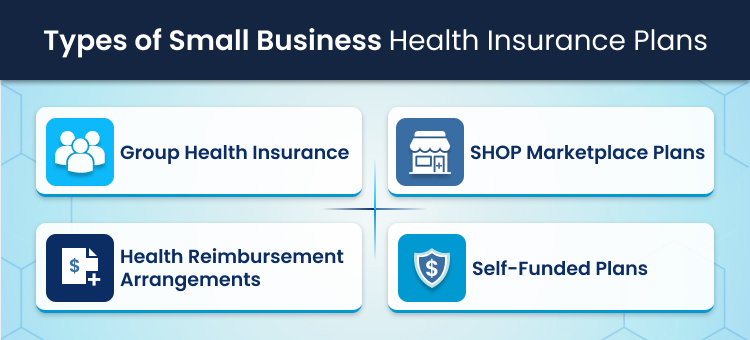
There is no single solution that works for every business. Understanding your small business health insurance options helps you make a smarter choice for your team and your budget.
1. Group Health Insurance for Small Business
Group health insurance for small businesses is the most traditional and widely used model. You purchase a policy through an insurer or broker that covers all eligible employees under one plan. Premiums are typically split between the employer and the employee.
Key features:
- Broad network of doctors and hospitals
- Shared premium costs lower the burden on individuals
- May include dental and vision add-ons
- Most carriers require a minimum of 2 enrolled employees
2. SHOP Marketplace Plans
The Small Business Health Options Program (SHOP) marketplace allows businesses with 1–50 full-time employees to purchase ACA-compliant plans. One advantage of SHOP is that businesses may qualify for the Small Business Health Care Tax Credit, worth up to 50% of premiums paid if they have fewer than 25 employees earning below a certain threshold.
3. Health Reimbursement Arrangements (HRAs)
HRAs are a flexible, budget-controlled alternative. Instead of purchasing a group plan, you reimburse employees for individual insurance premiums and qualified medical expenses. The Qualified Small Employer HRA (QSEHRA) is designed specifically for businesses with fewer than 50 employees and allows tax-free reimbursements up to IRS-set limits.
4. Self-Funded (Self-Insured) Plans
Larger small businesses, typically with 50+ employees, sometimes opt to self-fund their health plans. Instead of paying fixed premiums to an insurer, you pay employee claims directly. This approach can reduce overhead but carries more financial risk and administrative responsibility.
Understanding Small Business Health Insurance Costs
One of the first questions business owners ask is: What will this actually cost me? Small business health insurance costs vary based on several key factors.
| Cost Factor | How It Affects Your Premium |
| Number of Employees | More employees can spread risk and sometimes lower per-person costs |
| Employee Age | Older employees generally lead to higher premiums |
| Plan Type (HMO/PPO/EPO) | PPOs offer more flexibility but are typically more expensive |
| Geographic Location | Premiums vary significantly by state and even by county |
| Deductible Level | Higher deductibles lower monthly premiums, but increase out-of-pocket risk |
| Employer Contribution % | How much you cover vs. employee share affects your monthly outlay |
On average, small businesses that offer group coverage contribute between 70%–80% of the employee-only premium. According to KFF data, the average annual premium for employer-sponsored single coverage in recent years has exceeded $8,000, with family coverage surpassing $23,000, though employer contributions significantly offset what employees pay out of pocket.
Employee Health Insurance for Small Business: What You Need to Offer
Setting up employee health insurance for a small business doesn’t have to be complicated. Here is a practical breakdown of what your plan should typically include to be competitive and compliant.
Minimum Essential Coverage (MEC)
Under the Affordable Care Act, any health plan sold through SHOP or offered to employees must cover the ten essential health benefits, which include preventive care, emergency services, mental health services, prescription drugs, and maternity care, among others.
Coverage for Dependents
Most employees will ask whether their spouse and children are covered. While you are not required to contribute to dependent premiums, offering a plan that includes family coverage, even if the employee pays the added cost, makes your benefits package far more attractive.
Dental and Vision Add-Ons
While medical is the priority, many small business group health insurance plans can be paired with dental and vision coverage at modest additional cost. These add-ons are often cited by employees as highly valued perks.
Health Insurance for Small Business Owners: What About You?
A question that often gets overlooked: what happens to you as the owner? Health insurance for small business owners works differently depending on your business structure.
- Sole Proprietors & Self-Employed: You can deduct 100% of health insurance premiums from your taxable income, including coverage for a spouse and dependents.
- S-Corp Owners: Premiums are included in W-2 wages, but you can take a self-employed health insurance deduction on your personal return.
- Partnership & LLC Members: Partners can typically deduct premiums paid on their behalf as a business expense.
Regardless of structure, your own health coverage should be part of your compensation planning, not an afterthought.
How to Choose the Right Small Business Health Insurance Plan
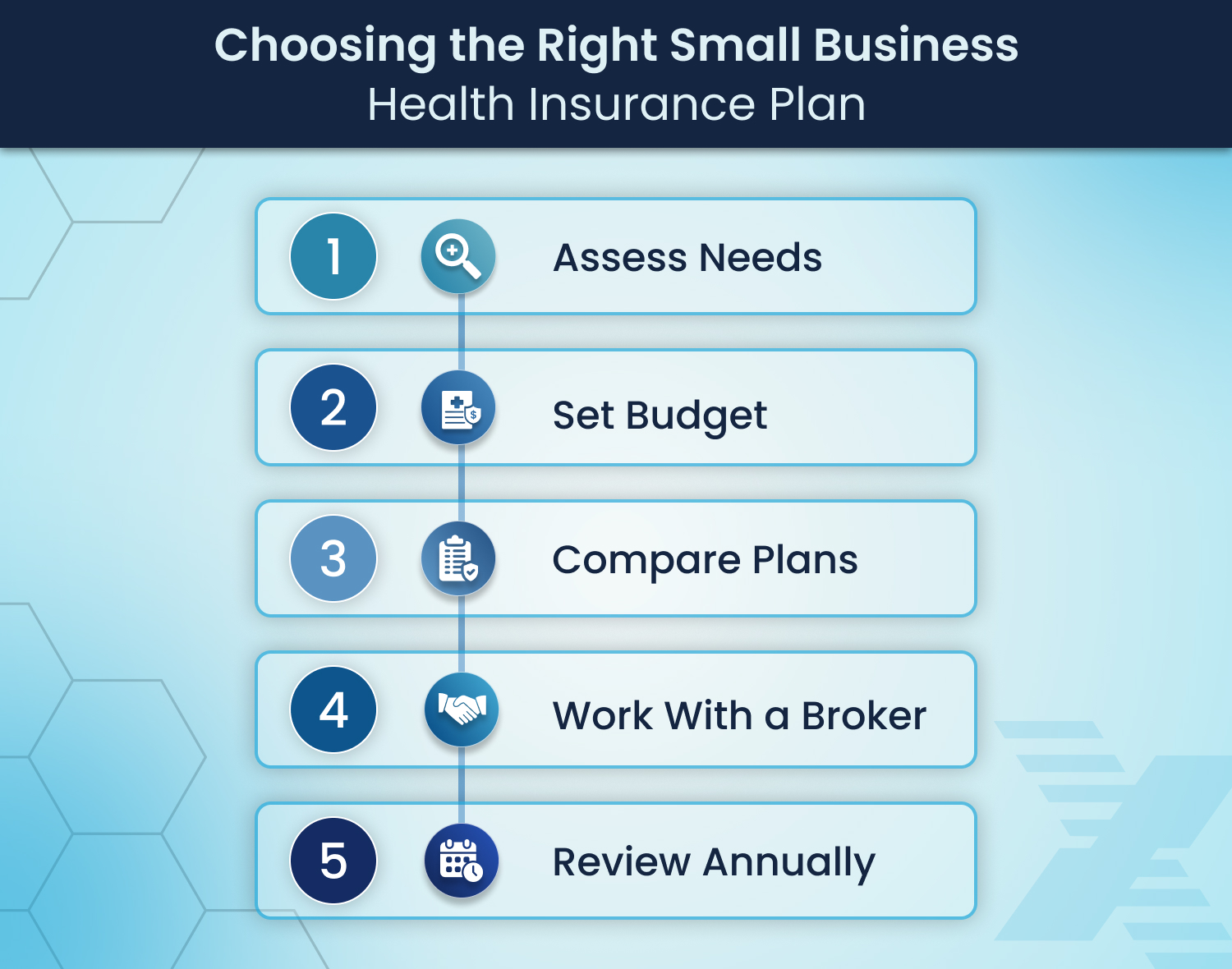
With so many small business health insurance options available, the process can feel overwhelming. Here is a step-by-step approach to narrowing it down.
- Assess Your Team’s Needs: Survey employees to understand what matters most: low premiums, low deductibles, specific doctors, or prescription coverage.
- Set a Realistic Budget: Determine how much you can contribute monthly. Most experts suggest starting at 50% of employee-only premiums at a minimum.
- Compare Plan Types: HMOs are lower-cost but restrict network choice. PPOs offer flexibility. HDHPs pair with HSAs for tax savings. Review what fits your workforce.
- Work With a Licensed Broker or Consultant. A broker familiar with business health insurance for small businesses can compare multiple carriers simultaneously and help you find plans you might miss on your own.
- Review Annually Insurance markets change. What was the best deal last year may not be competitive today. Revisit your plan options every renewal cycle.
Tax Advantages You Should Know About
One underappreciated aspect of offering small business group health insurance plans is the tax benefit for your business.
- Employer premium contributions are generally 100% tax-deductible as a business expense
- Payroll tax savings apply when employees pay their share of premiums through Section 125 cafeteria plans (pre-tax)
- The Small Business Health Care Tax Credit can offset up to 50% of premiums for qualifying employers through SHOP
- HSA contributions made by the employer are tax-free
Always consult with a tax professional to confirm which benefits apply to your specific situation, as rules vary based on business structure and employee count.
Common Mistakes Small Business Owners Make With Health Coverage
Even well-intentioned business owners can make errors that cost them money or employees. Here are the pitfalls to avoid:
- Choosing a plan based on premium alone: A lower monthly premium often means higher deductibles and out-of-pocket costs that discourage employees from using their coverage.
- Not offering dependent coverage options: Employees with families may choose a competitor who covers their household.
- Skipping the annual review: Plans that auto-renew without comparison shopping often lock you into outdated and overpriced terms.
- Misunderstanding the employer mandate: Businesses with 50+ full-time equivalent employees must offer coverage or face potential penalties. Even below that threshold, knowing the rules prevents surprises.
- Waiting too long to enroll: Most group plans have enrollment windows. Missing the deadline can mean going without coverage for months.
Small Business Health Insurance With 1 Employee: Is It Possible?
If you have a small operation, even just one employee besides yourself, you still have options. While traditional group plans typically require at least two enrolled members, there are several alternatives:
- QSEHRA (Qualified Small Employer HRA) for reimbursing individual plan costs
- Individual Coverage HRA (ICHRA) with no size minimum
- Association health plans if your industry has a qualifying trade group
- Some states allow solo group plan enrollment; check your state’s insurance rules
Small does not mean uninsured. With the right guidance, even a one-person operation can access meaningful coverage.
State-Level Considerations
Health insurance regulations differ significantly by state. Some states have expanded Medicaid and offer state-run marketplaces with additional small business plans. States like California, New York, and Massachusetts have more regulated insurance markets with guaranteed issue provisions, meaning insurers cannot deny coverage based on group health history.
When shopping for small business health insurance plans, always confirm what is available in your specific state, as your options, costs, and requirements can look very different from another business owner’s experience across state lines.
Final Thoughts: Protecting Your People and Your Business
Offering small business health insurance is one of the most impactful decisions you can make as an employer. Whether you have 2 employees or 50, there are plans designed to fit your scale, your budget, and your team’s needs.
From group health insurance for small businesses to HRAs, SHOP plans, and tax-efficient self-employed deductions, your coverage options are broader than you might think. The key is starting the research early, comparing multiple options, and working with someone who knows the market.
Small business health insurance is not just a perk; it is a signal to your team that you are invested in their well-being and the future of your company together.
FAQs
1. What is small business health insurance?
Small business health insurance is coverage offered by an employer to employees through a group plan or reimbursement options like HRAs. It helps businesses provide medical benefits while sharing costs with employees.
2. How many employees do you need to get small business health insurance?
Most traditional group plans require at least 2 employees to enroll. However, some options like ICHRA or QSEHRA can work for smaller teams, even with just one employee in some cases.
3. Do small businesses have to offer health insurance?
Not all small businesses are required to offer health insurance. The requirement depends on the number of full-time employees. Many small businesses still choose to offer coverage to stay competitive and retain employees.
4. How much does small business health insurance cost?
The cost depends on factors like employee age, location, plan type, deductible level, and employer contribution. Employers usually pay a portion of the premium, while employees cover the rest.
5. What is the best health insurance option for a small business?
The best option depends on your budget and team size. Group plans are common for structured coverage, while HRAs are better for flexibility and cost control.
6. Can a small business offer health insurance to just one employee?
Yes, it is possible. While most group plans require multiple employees, options like QSEHRA or ICHRA allow businesses to offer benefits even with only one employee.
7. Is health insurance tax-deductible for small business owners?
Yes, in many cases, employer contributions are tax-deductible as a business expense. Some business owners may also qualify for additional deductions depending on their structure.
8. What is the difference between group health insurance and an HRA?
Group health insurance provides one plan for all employees through an insurer. An HRA allows employers to reimburse employees for individual plans and medical expenses, offering more flexibility.
9. Can small business owners get health insurance for themselves?
Yes, business owners can get coverage through group plans, individual plans, or reimbursement arrangements, depending on their business structure and employee setup.