
One of the first questions most people ask about accident insurance is simple: what is this actually going to cost me every month? It is a fair question, and the honest answer is that an accident insurance premium is one of the more affordable additions you can make to your coverage, though the exact number depends on several factors specific to you and the policy you choose.
This guide breaks down what typically drives an accident insurance premium up or down, what a realistic monthly cost looks like, and how to find coverage that fits comfortably into your budget.
What Is an Accident Insurance Premium
An accident insurance premium is the amount you pay, usually monthly, to keep your accident insurance policy active. In exchange for that premium, the policy pays you a cash benefit if you experience a covered accidental injury, based on a fixed schedule of benefits built into the plan.
Unlike major medical premiums, which are influenced by broad factors like your entire health history and the comprehensive scope of coverage, an accident insurance premium tends to be simpler and considerably lower, since the policy only pays for specific accidental injuries rather than the full range of medical needs a primary health plan covers. If you are new to this type of coverage, our guide on what accident insurance is and how it works is a good starting point before diving into pricing.
Average Accident Insurance Premium
While exact pricing varies by insurer and location, accident insurance is generally considered one of the most budget-friendly types of supplemental coverage available. Individual accident-only policies commonly range from around 15 to 50 dollars a month, though some basic policies can start even lower, and more robust plans with higher benefit amounts can run higher.
For context, supplemental health coverage as a category, which includes accident, critical illness, and hospital indemnity insurance, is often priced in a similar affordable range, frequently landing between 30 and 80 dollars a month depending on the specific product and benefit level chosen. Compared to a primary health insurance premium, an accident insurance premium is a relatively small monthly addition for the financial protection it provides.
Factors That Affect Your Accident Insurance Premium
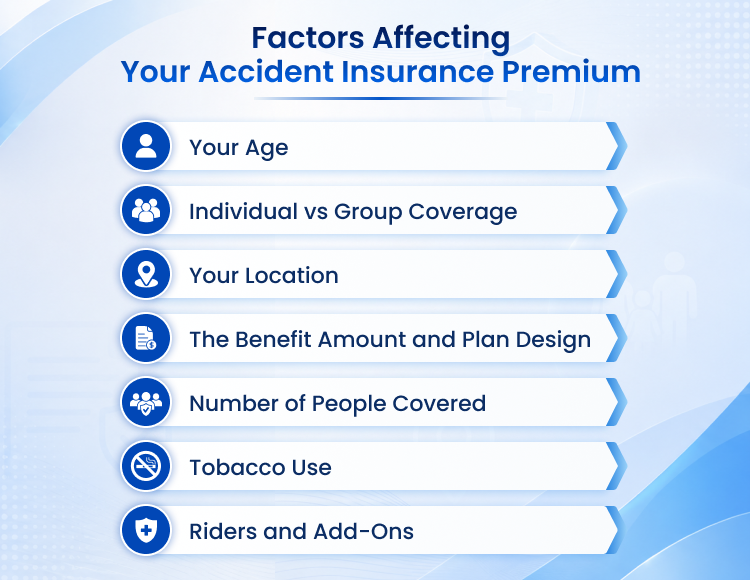
No two accident insurance premiums look exactly alike, because insurers weigh a combination of personal and policy-level factors when setting the price. Here are the main drivers.
Your Age
Age is one of the more significant factors in accident insurance pricing. Older applicants generally pay somewhat more than younger applicants, since risk profiles shift with age. That said, because accident insurance is priced very differently from major medical coverage, the age-related increase tends to be far more modest than what you would see with health insurance premiums.
Individual vs Group Coverage
If you can access accident insurance through an employer as a group benefit, your premium is often lower than buying an equivalent individual policy on your own, since group plans benefit from shared risk pooling and, in many cases, an employer subsidy covering part of the cost. Individual policies purchased directly are usually priced a bit higher, since you are covering the full premium yourself, but they offer more control and portability if you change jobs.
Your Location
Where you live can influence your accident insurance premium, since state regulations, cost of care, and insurer competition all vary geographically. Two people with identical coverage levels in different states may see somewhat different pricing as a result.
The Benefit Amount and Plan Design
The single biggest driver of your premium is the benefit schedule you choose. A basic plan with lower payout amounts for each covered injury will generally cost less per month than a more robust plan offering higher payouts for the same injuries. If you want a larger cash benefit for events like fractures, hospital stays, or ambulance transport, expect a correspondingly higher premium.
Number of People Covered
An individual policy covering just you will cost less than a policy extended to cover a spouse or children. Many insurers offer family rate structures, which can be more efficient than purchasing separate individual policies for each family member.
Tobacco Use
Some insurers factor tobacco use into accident insurance pricing, similar to how it affects other insurance products, though this varies by carrier and is worth confirming directly with the specific plan you are considering.
Riders and Add-Ons
Many accident insurance policies allow you to add optional riders, such as accidental death and dismemberment coverage or enhanced sports injury benefits. Each rider you add typically increases your premium slightly in exchange for broader protection.
Is a Higher Accident Insurance Premium Worth It
A higher premium generally buys a richer benefit schedule, meaning larger payouts for the same covered injuries. Whether that trade-off makes sense depends on your specific situation.
If your primary health plan carries a high deductible, a richer accident insurance benefit can more meaningfully offset that deductible after a covered injury, which may justify the higher premium. If your primary plan already has a low deductible and strong coverage, a more basic, lower-cost accident policy may be all you need as a supplemental cushion.
Comparing your current plan’s deductible and out-of-pocket maximum against the benefit schedule of any accident policy you are considering is the most reliable way to judge whether the extra premium is worth it for your household. If you are still deciding on your primary coverage, our guide to choosing the best health insurance plan walks through how supplemental options like accident insurance typically fit alongside a primary plan.
How to Find an Affordable Accident Insurance Premium
If keeping your premium low is the priority, a few strategies can help.
Check with your employer first. Group accident insurance offered through work is frequently the lowest cost option available, since it benefits from group pricing and sometimes a partial employer contribution.
Choose a benefit level that matches your actual risk. There is no need to pay for the richest plan available if a moderate benefit schedule already comfortably covers what your health plan’s deductible would leave you owing.
Enroll while you are younger, if the option is available. Because age is a pricing factor, locking in a policy earlier can help keep your premium lower for longer, particularly with plans that do not significantly increase rates as you age.
Compare multiple insurers. Accident insurance pricing can vary meaningfully between carriers for similar benefit levels, so requesting a few quotes before choosing a policy is worth the extra few minutes.
Bundle with other supplemental coverage when it makes sense. Some insurers offer a modest discount when you combine accident insurance with other supplemental products like critical illness or hospital indemnity coverage. Our overview of whether hospital indemnity insurance is worth it, and our guide on whether critical illness insurance is worth it, both cover how these products commonly get bundled with accident coverage as part of a broader supplemental strategy.
Accident Insurance Premium vs the Cost of an Uncovered Accident

It helps to put the premium in perspective against what an accident can actually cost without any supplemental coverage in place. A single emergency room visit, ambulance ride, and follow-up care for something as common as a broken bone can add up to a meaningful out-of-pocket bill once your health plan’s deductible and coinsurance are applied.
An accident insurance premium in the range of 15 to 50 dollars a month, paid consistently over the course of a year, is a relatively small amount compared to the potential financial impact of a single serious accident landing entirely on your deductible and coinsurance. This is part of why many households, especially those on high deductible health plans, view the premium as a reasonable trade for the added financial protection. This is a common theme for anyone weighing supplemental coverage, including part-time workers balancing a leaner primary plan against a tighter budget.
What Happens If You Stop Paying Your Premium
Like most insurance products, an accident insurance policy generally requires the premium to be paid on time to stay active. If a premium payment is missed, most insurers provide a grace period before the policy lapses, though the specific length of that grace period varies by carrier and state.
If a policy lapses, coverage typically ends, meaning any accident occurring after that point would not be eligible for a benefit. Setting up automatic payments is a simple way to avoid an accidental lapse in coverage, particularly since these premiums are usually low enough that missing a payment is more often an oversight than a budgeting issue.
Accident Insurance Premium by Age: What to Expect
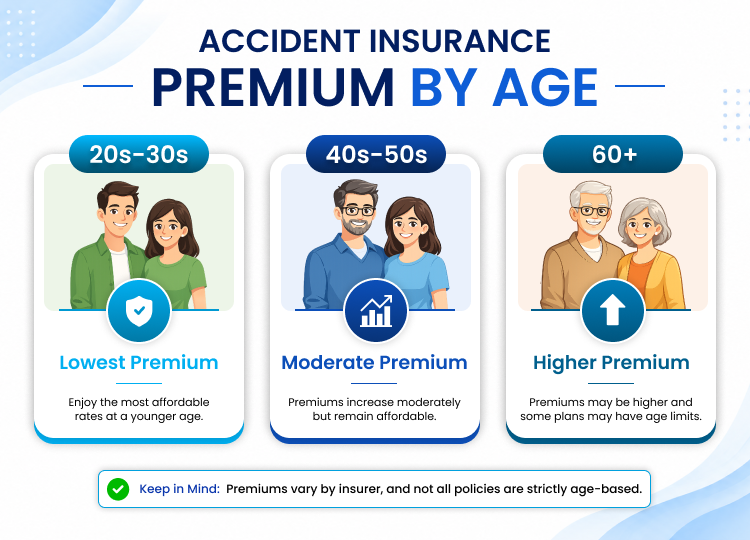
While exact numbers vary by insurer, it can help to have a general sense of how age tends to influence pricing.
- Young adults in their 20s and early 30s often see the lowest accident insurance premiums, since insurers generally view this age group as lower risk for the types of claims accident policies pay out on.
- Adults in their 40s and 50s typically see a moderate increase compared to younger applicants, though still well within an affordable range compared to major medical premiums.
- Adults 60 and older may see a further increase, and some policies place upper age limits on new enrollment, so it is worth confirming eligibility if you are shopping for coverage later in life.
These are general patterns rather than guarantees, since underwriting practices differ between insurers, and some accident policies use composite pricing that does not vary as sharply by age as other insurance products do.
Frequently Asked Questions
How much does an accident insurance premium typically cost per month?
Individual accident insurance premiums commonly range from about 15 to 50 dollars a month, depending on the benefit level, your age, and where you live, though basic policies can sometimes cost less and more comprehensive plans can cost more.
Does an accident insurance premium increase every year?
This depends on the specific policy. Some accident insurance plans have premiums that remain level for the life of the policy, while others may adjust over time. It is worth confirming this detail before enrolling.
Is a group accident insurance premium cheaper than an individual policy?
Generally yes. Group accident insurance offered through an employer often costs less than an equivalent individual policy, partly due to group pricing and sometimes a partial employer contribution toward the premium.
Does adding my family increase my accident insurance premium significantly?
Adding dependents does increase the premium, but many insurers offer family rate structures that are more efficient than purchasing separate individual policies for each family member.
Can my accident insurance premium go up if I file a claim?
In most cases, no. Because accident insurance pays a fixed benefit based on a predetermined schedule rather than reimbursing variable costs, filing a claim typically does not increase your premium the way it might with some other insurance types.
Is it worth paying a higher premium for a richer accident insurance benefit schedule?
It can be, particularly if your primary health plan carries a high deductible or significant coinsurance. Comparing the benefit schedule against your actual out-of-pocket exposure is the best way to decide.
Does tobacco use affect my accident insurance premium?
Some insurers factor tobacco use into pricing for accident insurance, though this varies by carrier, so it is worth confirming with the specific policy you are considering.
Can I lower my accident insurance premium by choosing a lower benefit amount?
Yes. Choosing a more modest benefit schedule is one of the most direct ways to reduce your monthly premium, since the benefit amount is one of the biggest pricing factors.