Automatic renewal can help prevent a gap in health coverage, but it does not guarantee that your 2027 plan will have the same price, doctors, prescriptions, or benefits as it did in 2026.
That distinction matters. The Centers for Medicare & Medicaid Services reported 8.8 million automatic reenrollments for the 2026 plan year. Many people rely on the process, yet an automatically renewed plan may not be the best available option for the year ahead.
Before keeping your plan, review the new premium, deductible, provider network, drug list, benefits, and financial assistance. Also confirm whether you must take action. HealthCare.gov says automatic reenrollment happens in many cases, but not every enrollee is guaranteed to be renewed automatically.
Quick takeaway: Treat auto-renewal as a safety net, not a recommendation. Review your official renewal notice, update your Marketplace application, and compare your 2027 choices before your state’s deadline.
Compare individual health plan options with AHiX, or call 800.800.5735 to speak with a licensed insurance agent. Use HealthCare.gov or your official state Marketplace for final eligibility decisions and premium tax credits.
How Auto-Renewal Works
Health insurance auto-renewal, also called automatic reenrollment, may keep your Marketplace coverage in place when you do not actively select a plan for the new year.
If your current plan remains available, you may be reenrolled in it with its 2027 price and benefits. If the plan is discontinued, the Marketplace may match you with another plan. In some situations, automatic reenrollment may not be available at all.
Review every notice from your Marketplace and insurance company. Those notices should tell you whether:
- Your current plan will continue in 2027
- You have been matched with a replacement plan
- Your premium or benefits will change
- You need to update information or select a plan
- You must submit documents to maintain eligibility or savings
Even if your plan is set to renew, log in to your official Marketplace account and confirm the details. Automatic reenrollment does not shop the market or decide which plan best fits your needs.
Can Your Plan Change?
Yes. A plan can change from one year to the next even when its name looks familiar. Your 2027 renewal may have a different:
- Monthly premium
- Deductible
- Out-of-pocket maximum
- Provider network
- Prescription drug formulary
- Copay or coinsurance amount
- Prior-authorization requirement
- Coverage rule for a treatment or medication
If your 2026 plan is no longer offered, you may be matched with a different plan and, in some cases, a different insurer. A replacement plan is intended to preserve coverage, but it may not include the same doctors, hospitals, medications, or cost structure.
Do not rely only on the plan name or metal level. Compare the official Summary of Benefits and Coverage, provider directory, drug formulary, and renewal notice for the exact 2027 plan.
Eight Things to Check
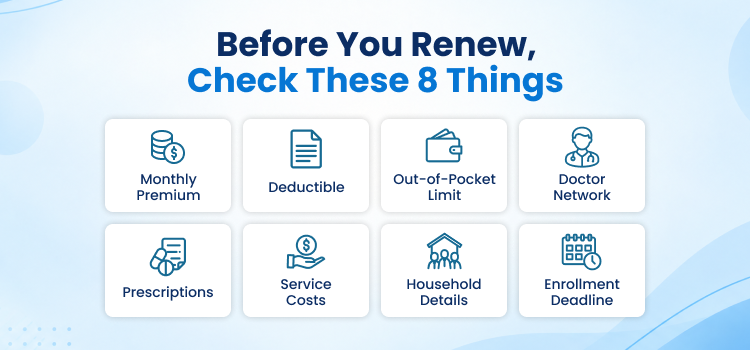
1. Your net monthly premium
Start with the amount you would actually pay each month after any advance premium tax credit or state assistance. Do not assume that last year’s subsidy or net premium will continue.
For 2027, federal premium tax credits generally require household income between 100% and 400% of the federal poverty level, along with the other eligibility rules. Some state-based Marketplaces provide separate state-funded assistance, including help for certain households outside the federal range. Complete or update the application through your official Marketplace before concluding that you do not qualify for savings.
2. Your deductible
The premium is only one part of the cost. Compare the amount you must pay before the plan begins covering many services. Check whether the plan has separate medical and prescription deductibles.
A plan with a lower premium can still cost more overall if its deductible is much higher and you expect to use regular care.
3. Your out-of-pocket maximum
This is the most you generally pay in a plan year for covered, in-network care through deductibles, copays, and coinsurance. Premiums, out-of-network care, and services the plan does not cover generally do not count toward this limit.
Compare the 2027 limit with your 2026 limit, especially if you expect surgery, pregnancy care, specialist visits, or ongoing treatment.
4. Your doctors and hospitals
Provider networks can change annually. Confirm each important doctor, specialist, clinic, hospital, laboratory, and pharmacy with both the insurer and the provider.
Ask about the exact plan, not only the insurance company. One insurer may use different networks for different plans. Save screenshots or written confirmation when possible.
5. Your prescriptions
Check every medication on the 2027 formulary. Look beyond whether the drug is listed and confirm:
- Its coverage tier
- Your copay or coinsurance
- Whether a deductible applies
- Prior-authorization requirements
- Step-therapy rules
- Quantity limits
- Preferred pharmacy restrictions
If a medication is not covered, review alternatives and the plan’s exception or appeal process before enrolling.
6. Your service costs
Compare copays and coinsurance for the care you are most likely to use, including primary care, specialists, urgent care, emergency care, mental health treatment, diagnostic imaging, laboratory work, and hospital services.
An inexpensive office-visit copay does not necessarily mean the plan is inexpensive overall. Expensive services may still be subject to the deductible or coinsurance.
7. Your household information
Update your expected 2027 income, household members, address, and access to other coverage. These details can affect eligibility for premium tax credits, cost-sharing reductions, Medicaid, or the Children’s Health Insurance Program.
Estimate income as accurately as possible, then report material changes during the year. If advance premium tax credits are based on incorrect information, the amount may need to be reconciled on your federal tax return.
8. Your Marketplace deadline
Confirm which Marketplace serves your state and the date by which you must select a plan. HealthCare.gov dates do not automatically apply to every state-based Marketplace.
Use the federal Marketplace directory to reach the correct official enrollment site. Be cautious with advertisements or websites that resemble a government Marketplace but are not the official exchange.
Compare Your 2027 Options
Use the same information for every plan so the comparison is fair.
- Update your Marketplace application. Correct the household, income, address, and other coverage information before comparing net premiums.
- Read your renewal notice. Identify changes to the premium, deductible, out-of-pocket maximum, network, formulary, and benefits.
- List your expected care. Include regular prescriptions, doctors, planned procedures, therapy, and other recurring needs.
- Compare at least two alternatives. Review other ACA-compliant Marketplace plans and, when appropriate, ACA-compliant plans sold outside the Marketplace.
- Estimate the full-year cost. Consider 12 months of premiums plus the cost-sharing you reasonably expect to pay.
- Check the worst-case exposure. Add 12 months of premiums to the plan’s in-network out-of-pocket maximum. Remember that uncovered and out-of-network services can create additional costs.
Only plans purchased through the official Marketplace can receive Marketplace premium tax credits. An ACA-compliant plan sold outside the Marketplace may still be an option, but it does not receive those tax credits.
Short-term and other non-ACA-compliant products are not direct substitutes for comprehensive Marketplace coverage. Depending on the policy and state, they may be unavailable, medically underwritten, exclude pre-existing conditions, omit essential health benefits, or impose other coverage limits. Review the policy documents and state rules carefully before considering one.
When Keeping It Makes Sense
Keeping your current plan may be reasonable when:
- The 2027 net premium remains affordable
- Your doctors and facilities remain in-network
- Your prescriptions remain covered at acceptable costs
- The deductible and out-of-pocket maximum fit your budget
- The plan still covers the services you expect to use
- Your eligibility and household information are current
- Other available plans do not offer a meaningful advantage
The goal is not to switch automatically. It is to make an informed choice after checking what changed.
When to Consider Switching
Compare alternatives closely when:
- Your net premium rises significantly
- Your plan is discontinued or you are matched with a replacement
- A doctor, hospital, pharmacy, or medication is no longer covered
- Your deductible or out-of-pocket maximum increases
- Your household, income, address, or access to employer coverage changes
- You expect different medical needs in 2027
- Another plan offers a better combination of network, drug coverage, and total cost
If you experience a qualifying life event, such as losing other health coverage, getting married, having a baby, or moving, you may qualify for a Special Enrollment Period outside annual Open Enrollment. Medicaid and CHIP enrollment is available year-round for people who qualify.
2027 Enrollment Deadlines
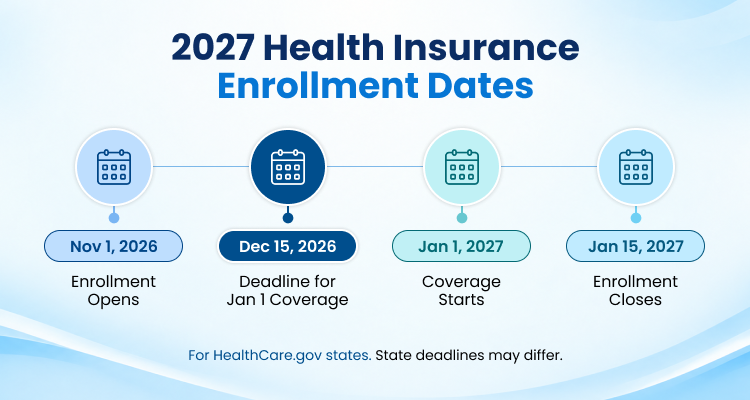
For states that use HealthCare.gov, the 2027 schedule is:
| Date | HealthCare.gov deadline |
| November 1, 2026 | Open Enrollment begins. |
| December 15, 2026 | Last day to enroll in or change a plan for coverage starting January 1, 2027. |
| January 1, 2027 | Coverage begins for people who enrolled by December 15 and completed any required premium payment. |
| January 15, 2027 | Open Enrollment ends. Plans selected from December 16 through January 15 generally begin February 1. |
These dates are not universal nationwide. State-based Marketplaces can use different windows. For example:
- Idaho: October 15 through December 15, 2026
- Connecticut: October 23, 2026 through January 15, 2027
Other states may also use different opening dates, closing dates, or effective-date rules. Confirm the schedule on your official state Marketplace before relying on a deadline.
If You Take No Action
Several outcomes are possible:
- You may be automatically reenrolled in your current plan at its 2027 price and benefits.
- You may be matched with a replacement plan if your current plan is discontinued.
- You may receive an incorrect amount of financial assistance if your application information is outdated.
- You may not be automatically reenrolled and could have a coverage gap.
- You may lose the ability to change Marketplace plans after Open Enrollment unless you qualify for a Special Enrollment Period.
Automatic reenrollment also does not pay premiums for you. If your existing plan renews, continue paying the insurer by its stated due dates. If you select a new plan or are moved to a new insurer, follow the payment instructions and pay any required first premium directly to the insurance company. Confirm that the insurer shows your coverage as active.
Your 2027 Renewal Checklist
- Read every Marketplace and insurer renewal notice
- Confirm whether your current plan will continue
- Update your 2027 income and household information
- Compare the net monthly premium after savings
- Review the deductible and out-of-pocket maximum
- Verify doctors, hospitals, laboratories, and pharmacies
- Check every prescription and its coverage rules
- Compare copays and coinsurance for expected care
- Review at least two other ACA-compliant plans
- Confirm your state’s official Marketplace and deadlines
- Follow the insurer’s premium-payment instructions
- Confirm that your 2027 coverage is active
Frequently Asked Questions
Do Marketplace plans renew automatically?
Many Marketplace plans can renew automatically, but automatic reenrollment is not guaranteed in every case. Review your official Marketplace and insurer notices, update your application, and confirm your 2027 enrollment status.
Can I receive a different plan?
Yes. If your current plan is discontinued, the Marketplace may match you with another plan and sometimes another insurer. Compare the replacement plan’s network, prescriptions, benefits, and costs before the deadline.
Can costs change after auto-renewal?
Yes. The gross premium, financial assistance, deductible, out-of-pocket maximum, copays, and coinsurance can change for 2027. Review the new net premium and total potential costs rather than relying on your 2026 amount.
Should I update my Marketplace application?
Yes. Update expected income, household members, address, and access to other coverage. Accurate information helps the Marketplace determine eligibility for premium tax credits, cost-sharing reductions, Medicaid, or CHIP.
What is the federal 2027 deadline?
For HealthCare.gov states, Open Enrollment runs from November 1, 2026 through January 15, 2027. Enroll or change plans by December 15 for coverage starting January 1. State-based Marketplace deadlines may differ.
What happens if I miss Open Enrollment?
You generally need a qualifying life event to enroll in or change Marketplace coverage after Open Enrollment. If eligible, you can enroll in Medicaid or CHIP at any time of year.
Does auto-renewal pay my premium?
No. Automatic reenrollment does not make premium payments. Continue paying your current insurer as instructed, or pay any required first premium for a newly selected or replacement plan. Confirm that the insurer shows the coverage as active.
Are short-term plans equivalent to ACA plans?
No. Short-term plans are not ACA-compliant comprehensive coverage. Availability and rules vary, and a policy may exclude pre-existing conditions, omit essential health benefits, or impose other limits. Review the contract and state rules before considering one.
The Bottom Line
Auto-renewal can protect you from an accidental coverage gap, but it cannot tell you whether your renewed plan is still the right choice. A short annual review can reveal changes to your premium, doctors, prescriptions, deductible, and financial assistance before those changes become expensive surprises.
Update your official Marketplace application, compare the renewed plan with other 2027 options, and complete any required selection or payment before your state’s deadline.
Compare individual health plan options with AHiX, or call 800.800.5735 to speak with a licensed insurance agent. For premium tax credits and final Marketplace eligibility decisions, use HealthCare.gov or your official state Marketplace.
This article is for general educational purposes and is not tax, legal, or medical advice. Eligibility, plan availability, benefits, pricing, and enrollment dates vary by household, carrier, and state and may change. Refer to your official Marketplace, insurer documents, and appropriate licensed or qualified professionals for guidance about your situation.