

Washington State has one of the lowest uninsured rates in the country at 5.3%, thanks to Medicaid expansion and a robust state marketplace. But 2026 is a turning point. Subsidy expiration and Medicaid unwinding are already pushing more people out of coverage. If you are currently uninsured in Washington, this guide tells you exactly what you qualify for right now and how to get covered fast.
How Many People in Washington State Are Uninsured?
Washington State has made significant progress in reducing the number of uninsured residents. The state currently has an uninsured rate of approximately 5.3%, well below the national average of 9.8% and among the lowest in the United States, ranking 19th nationally according to America’s Health Rankings.
That progress did not happen by accident. Washington was an early adopter of Medicaid expansion under the Affordable Care Act, and the state operates its own insurance marketplace, Washington Healthplanfinder, giving residents more options and greater local support than the federal exchange provides.
But the national picture provides important context for what is happening right now. According to KFF’s April 2026 analysis of the American Community Survey:
- 26.7 million Americans ages 0–64 were uninsured in 2024 — an increase of 1.3 million from 2023
- The national uninsured rate rose from 9.5% to 9.8% — the first increase since 2019
- That increase was driven almost entirely by Medicaid unwinding: states resuming eligibility redeterminations after pandemic-era continuous enrollment ended
The chart tells the story clearly. The national uninsured population peaked at 46.5 million in 2010, dropped dramatically after the ACA took effect, reached a record low of 25.3 million in 2023, and has now ticked back up. The trend in 2026 is expected to worsen because of subsidy expiration and Medicaid eligibility changes affecting every state, including Washington.
What this means for Washington residents specifically: Even though Washington expanded Medicaid, Medicaid unwinding has still affected hundreds of thousands of state residents who were disenrolled during the 2023–2024 eligibility redetermination process. Some transitioned to marketplace plans. Others fell into the uninsured gap. And with enhanced premium tax credits now expired, some who moved to marketplace coverage can no longer afford to stay.
Who Is Most Likely to Be Uninsured in Washington?
Understanding who is most affected helps you understand whether the programs below apply to your situation. The national data, which closely mirrors Washington State patterns, reveals a clear portrait of who falls through the cracks.
By Age
The age distribution of uninsured people is not random. According to KFF’s 2024 data, the uninsured population breaks down as follows:
| Age Group | Share of Uninsured Population |
| 0–18 (children) | 16.8% |
| 19–25 (young adults) | 15.4% |
| 26–34 (highest risk group) | 21.4% |
| 35–44 | 19.9% |
| 45–54 | 15.0% |
| 55–64 | 11.5% |
The 26–34 age group is the single largest uninsured population. Why? They age off parents’ plans at 26. They take jobs that don’t offer coverage. They earn too much for Medicaid in some states but too little to absorb marketplace premiums without subsidies. In Washington, this group has better options than in most states, but they often don’t know it.
Adults ages 19–64 are more likely to be uninsured than children (11.3% nationally vs. 5.9%), because children have broader Medicaid eligibility. In Washington, children can qualify for Apple Health at income levels well above 138% FPL.
By Income
Income is the strongest predictor of uninsurance. Nationally:
- 80.1% of uninsured people come from low-income families
- 85.1% live in a family where at least one person works
- In Washington specifically, the uninsured rate is 12.8% for people under 100% of the Federal Poverty Level and drops to 3.8% for those at 400% FPL or above
The counterintuitive finding: most uninsured people are in working families. The problem is not that people are not working; it is that their jobs either do not offer insurance or offer insurance they cannot afford.
By Race and Ethnicity
National data shows persistent disparities that are also present in Washington. Over six in ten (63.7%) uninsured Americans are people of color. Hispanic, American Indian or Alaska Native, Black, and Native Hawaiian or Pacific Islander residents are disproportionately represented in the uninsured population across all states, including Washington.
Why People Lose Coverage: The Real Reasons
The most common question people ask before searching for help is: “How did I end up here?” Understanding the cause tells you which solution applies.
Job loss or employer change
Most American health insurance is tied to employment. Lose the job, lose the coverage. In 2024, 60.5% of uninsured adults who were working were employed by a company that simply did not offer health insurance at all. Another 9.9% were offered coverage but did not qualify because they were part-time, temporary, or contract workers.
Medicaid unwinding
From April 2023 through 2024, Washington and every other state re-evaluated eligibility for all Medicaid enrollees after pandemic continuous enrollment ended. Millions nationally were disenrolled. Some were correctly disenrolled because their circumstances changed. Others lost coverage due to administrative reasons — outdated addresses, paperwork not completed — even though they still qualified. If you were on Apple Health and received a disenrollment notice, you may still be eligible and just need to reapply.
Turning 26
The ACA allows children to remain on parents’ plans until age 26. When that coverage ends, young adults enter what is statistically the highest-risk uninsured window of their lives if they do not have employer coverage or understand their marketplace options.
Cost
In 2024, 61.7% of uninsured adults said they were uninsured because coverage was not affordable. This is the leading reason. With enhanced premium tax credits now expired, this problem is sharper in 2026 than it has been since 2018.
Missed open enrollment
Many people do not realize health insurance has enrollment windows, and by the time they decide to get covered, the window has closed. What most people also do not realize: life events create Special Enrollment Periods that allow you to enroll outside the standard window.
Self-employment and gig work
Freelancers, independent contractors, and gig workers have no employer to offer coverage. Many assume marketplace plans are unaffordable without understanding the subsidies available to them.
What Happens If You Stay Uninsured
Being uninsured is not just an inconvenience. The financial and health consequences are severe and well-documented.
The Health Consequences
Uninsured adults are significantly less likely to receive preventive care, routine screenings, and treatment for chronic conditions. According to KFF’s 2024 data:
- 38.6% of uninsured adults delayed, skipped, or did not get needed care or medication due to cost, more than twice the rate of privately insured adults (17.0%)
- Uninsured adults with chronic conditions were 3 to 4 times more likely to delay or forgo needed medical care compared to insured adults with the same condition
- Research consistently demonstrates that gaining coverage, particularly through Medicaid, reduces mortality
The Financial Consequences
The costs of being uninsured are not limited to higher healthcare bills. They cascade.
- 59% of uninsured adults reported that they or someone in their household had problems paying for healthcare, compared to 30% of insured adults
- 62% of uninsured adults reported having healthcare debt compared to 44% of insured adults
- Uninsured adults are more likely to have overdrawn checking accounts, have been contacted by debt collection agencies, and have used payday loans
The specific medical bills that create this debt:
| Medical Event | Approximate Cost Without Insurance |
| Emergency room visit | $1,500 – $3,200 |
| Broken arm with surgery | $16,000 – $25,000 |
| Appendectomy | $33,000 average |
| 3-day hospital stay | $30,000 average |
| Heart attack treatment | $75,000 – $150,000 |
| Cancer diagnosis and initial treatment | $150,000+ |
Meanwhile, many Washington State residents can access health coverage for $0 to $50 per month, depending on their income. The math of going uninsured rarely favors the individual.
Your Options in Washington State, Ranked

Washington is one of the best states in the country for uninsured people to find coverage. Here are all the available options, ordered from lowest cost to highest, with Washington-specific details.
Option 1: Washington Apple Health (Medicaid) — Free
Best for: Adults earning under approximately $20,783/year (single), families with income under 138% of the Federal Poverty Level, children, and pregnant women at higher income thresholds.
Washington Apple Health is the state’s Medicaid program and is among the most comprehensive in the country. It covers:
- Doctor and specialist visits
- Hospital care and surgery
- Prescription drugs
- Mental health and substance use services
- Dental and vision (for many enrollees)
- Preventive care with no cost-sharing
Cost to you: $0 premium in most cases. Minimal or no copays for most services.
Key Washington advantage: Unlike states that have not expanded Medicaid, Washington covers adults up to 138% FPL with no coverage gap. If you are uninsured and your income falls below that threshold, you almost certainly qualify — and you can apply any time of year, not just during open enrollment.
If you were recently disenrolled: The Medicaid unwinding process disenrolled many people during 2023–2024, including some who were still eligible but lost coverage for administrative reasons. If you lost Apple Health coverage in the last year, reapply immediately. Your eligibility may not have actually changed.
How to apply: Washington Healthplanfinder (wahealthplanfinder.org) or call 1-855-923-4633. AHiX advisors can also guide you through eligibility and application at no cost.
Option 2: Washington State Basic Health Plan (Subsidized Marketplace) — Low-Cost
Best for: Adults and families earning between 138% and 400% FPL (roughly $20,783–$58,320 for a single person).
Washington Healthplanfinder is the state-run ACA marketplace. Plans are available in Bronze, Silver, Gold, and Platinum tiers. Premium tax credits (subsidies) are still available at the federal level for incomes between 100% and 400% FPL. However, the enhanced subsidies that had lowered costs for higher earners expired at the end of 2025.
What this means for your cost in 2026:
| Your Annual Income (Single) | Estimated Monthly Premium After Subsidy |
| $22,000 (~138% FPL) | $0 – $66/month |
| $28,000 | $27 – $130/month depending on plan |
| $40,000 | $100 – $200/month, depending on plan |
| $62,600 (~400% FPL) | $200 – $350/month (subsidy cliff) |
Washington-specific advantage: Washington has its own state exchange with a dedicated navigator program and locally licensed agents. The state also has historically offered additional state-level assistance programs. Check wahealthplanfinder.org directly, not just healthcare.gov, for Washington-specific assistance options.
ACA plans in Washington cover:
- Pre-existing conditions from day one, with no exceptions
- Preventive care at no additional cost
- Mental health and substance use services
- Prescription drugs
- Maternity and newborn care
- Emergency services
When can you enroll? Open enrollment runs from November 1 to December 15 for the following year. But if you lost coverage due to a qualifying life event (job loss, divorce, moving, income change), you may qualify for a Special Enrollment Period right now and can enroll within 60 days of that event.
Option 3: Special Enrollment Period (SEP) Apply Now
Best for: Anyone who experienced a qualifying life event in the past 60 days.
One of the most important things to understand if you are currently uninsured: you may not have to wait for open enrollment. You qualify for a Special Enrollment Period if you have recently:
- Lost health coverage (job loss, losing employer coverage, losing Medicaid eligibility)
- Turned 26 and aged off a parent’s plan
- Got married, divorced, or had a baby
- Moved to Washington State or to a new coverage area within the state
- Experienced a significant income change that affects your subsidy eligibility
You have 60 days from the qualifying event to enroll through a SEP. Missing that window means waiting until November. Acting now may mean coverage starting as soon as the first of next month.
Option 4: Catastrophic Health Plan — Low Premium, High Deductible
Best for: Generally healthy individuals under 30, or those over 30 who qualify for a hardship exemption.
Catastrophic plans carry the lowest premiums of any ACA-compliant plan. In 2026, the deductible is approximately $9,450 before most benefits kick in — but they cover all preventive care with no cost-sharing, and three primary care visits per year before the deductible applies.
The CMS expanded hardship exemption eligibility for catastrophic plans in 2026 specifically because of the premium surge caused by subsidy expiration. If you are experiencing affordability hardship, you may qualify for a catastrophic plan even if you are over 30. This gives you financial protection against major medical events at the lowest possible premium — often $50–$120/month for a healthy adult.
Option 5: Short-Term Health Insurance — Temporary Gap Coverage
Best for: People who are healthy, between jobs, and need something right now while they sort out longer-term coverage.
Short-term plans are not ACA-compliant. They do not cover pre-existing conditions, maternity care, mental health services, or other essential health benefits. In Washington State, short-term plans are limited in duration by state regulations.
Use these as a stopgap — not a permanent solution. They protect you against an unexpected accident or illness while you transition to a qualifying plan.
Honest warning: If you have any ongoing medical needs or take prescription medications, a short-term plan will very likely not cover those costs. For people with chronic conditions, an ACA marketplace plan or Apple Health is the right choice even if it costs more.
Option 6: COBRA — Keep Your Employer Plan (Usually the Expensive Option)
Best for: People in the middle of ongoing treatment who need to keep the same doctors and cannot risk a gap.
If you recently lost employer-sponsored coverage, COBRA lets you continue that exact plan but you now pay 100% of the premium (both your share and what your employer was paying), plus a 2% administrative fee. That can easily run $500–$700/month for an individual or $1,500–$2,000/month for a family.
For most healthy people who are not in active treatment, an ACA plan through Washington Healthplanfinder will be significantly less expensive. A licensed AHiX agent can run a direct cost comparison for your specific situation.
Important: You have 60 days from losing coverage to elect COBRA. After that, the option is gone.
Option 7: Supplemental Plans Fill the Gaps
Best for: People who already have a primary plan but want protection against high deductibles, unexpected accidents, or serious illness.
Supplemental plans, accident insurance, critical illness insurance, and hospital indemnity insurance pay cash benefits when specific covered events happen. They work alongside your primary plan and typically cost $30–$80/month.
If your primary plan raised its deductible this year (common in 2026 as employers and carriers offset premium increases), a supplemental plan can close that gap affordably without changing your primary coverage.
How to Choose the Right Option for Your Situation

| Your Situation | Best First Step | Best Option |
| Income under ~$21K/year (single) | Apply for Apple Health immediately | Washington Apple Health (Medicaid) — free |
| Lost a job or had a life event recently | Check SEP eligibility within 60 days | ACA plan via Washington Healthplanfinder + SEP |
| Age 19–25, aging off parents’ plan | Check both Apple Health and the marketplace | Apple Health if income qualifies; otherwise, ACA Bronze |
| Self-employed, variable income | Estimate annual income, check subsidy | ACA marketplace plan; maximize IRA/HSA to reduce MAGI |
| Healthy, under 30, tight budget | Compare catastrophic vs Bronze plans | Catastrophic plan at lowest premium |
| In active medical treatment, just lost a job | Run COBRA vs. marketplace cost comparison | COBRA if ongoing treatment; ACA plan otherwise |
| Have basic coverage, high deductible | Add a supplemental layer | Accident or hospital indemnity supplemental plan |
| Small business owner, no group plan | Explore ICHRA as an alternative | ICHRA — set your own budget, employees shop independently |
What Is Changing in 2026 That Affects You

The coverage landscape in Washington State is shifting significantly in 2026. Understanding these changes is critical to making the right decision now.
Enhanced ACA subsidies expired December 31, 2025.
The premium tax credits that had lowered marketplace costs since 2021 are gone unless Congress acts to restore them. The impact for marketplace buyers in Washington: premiums are significantly higher than last year for anyone who was receiving enhanced subsidies. If you had marketplace coverage that suddenly became much more expensive at renewal, this is why.
Medicaid unwinding is complete.
Washington finished its Medicaid eligibility redetermination process by the end of 2024. If you were disenrolled and believe it was an error — or if your income has since dropped back below the eligibility threshold, you can reapply at any time.
More people are projected to lose coverage in the coming years.
The Congressional Budget Office projects that over 14 million more Americans will be uninsured by 2034 due to Medicaid eligibility changes in the 2025 reconciliation law and the expiration of enhanced marketplace subsidies. Washington State will feel this, though less severely than states that have not expanded Medicaid.
What to do right now:
If your premium went up significantly, do not simply accept the renewal. Re-shop your plan through Washington Healthplanfinder or through AHiX. In many cases, switching plans — even within the same metal tier — can save $500–$1,500 per year. And if your income changed, recheck your subsidy eligibility before assuming you cannot afford coverage.
How to Get Covered Today
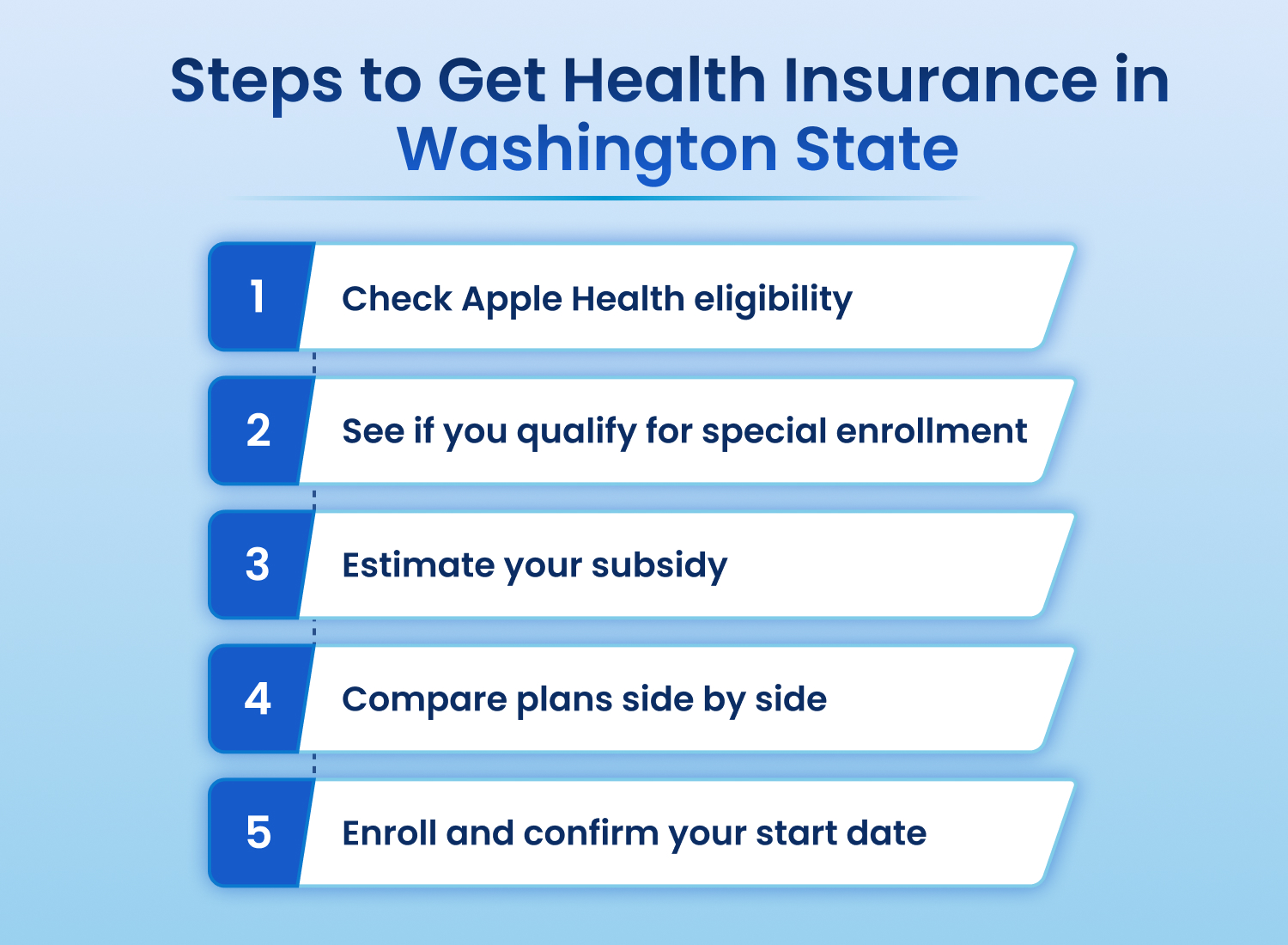
Getting covered in Washington State is faster and simpler than most people expect. Here is the exact path:
Step 1: Check Apple Health eligibility first:
If your household income is at or below approximately 138% FPL — about $20,783 for a single adult or $35,647 for a family of three — apply for Washington Apple Health before anything else. Coverage is comprehensive and free. Apply at wahealthplanfinder.org any time of year or call 1-855-923-4633.
Step 2: Check if you have a qualifying event for an SEP
If you lost coverage, had a life change, or moved in the past 60 days, you can enroll in a marketplace plan right now without waiting for open enrollment. This step expires 60 days after the qualifying event; acting immediately matters.
Step 3: Run a subsidy estimate before comparing plans
Use the KFF ACA Subsidy Calculator (kff.org/interactive/subsidy-calculator/) or have an AHiX agent run the numbers for you. Many Washington residents are surprised to find they still qualify for meaningful premium assistance even in 2026. Your subsidy amount is the number that matters most for choosing a plan.
Step 4: Compare plans side-by-side
At AHiX Marketplace, you can compare every ACA plan, short-term plan, and supplemental option available in your Washington zip code — side by side — including premium, deductible, out-of-pocket maximum, and provider network. The comparison takes about 10 minutes.
Step 5: Enroll and get your effective date
Coverage can become effective as soon as the first of the following month in most cases. If you have been uninsured, coverage can start within weeks.
Frequently Asked Questions
1. How many people in Washington State are uninsured?
Washington State has an uninsured rate of approximately 5.3%, which is significantly below the national average of 9.8%. However, the Medicaid unwinding process and the expiration of enhanced ACA subsidies are pushing more residents into uninsured status in 2026.
2. Can I get free health insurance in Washington State?
Yes. Washington Apple Health (Medicaid) is free for adults earning under approximately 138% of the Federal Poverty Level — about $20,783 per year for a single person. This includes comprehensive coverage with no premium, no deductible, and minimal or no copays for most services. You can apply any time of year, not just during open enrollment.
3. What if I missed open enrollment in Washington State?
You may still qualify for a Special Enrollment Period if you had a qualifying life event (job loss, losing coverage, turning 26, getting married, having a baby, or moving) in the past 60 days. You can also apply for Washington Apple Health at any time of year if your income qualifies. An AHiX licensed agent can determine which path applies to your situation.
4. Does Washington State require health insurance?
Washington State does not currently have a state-level individual mandate penalty for being uninsured. However, going without coverage carries serious financial risk a single ER visit costs $1,500–$3,200, and a hospital stay averages $30,000 — while subsidized marketplace coverage can cost as little as $10–$50/month for many Washington residents.
5. What is Washington Healthplanfinder?
Washington Healthplanfinder is Washington State’s own ACA health insurance marketplace. It is where Washington residents compare and enroll in ACA-compliant plans, check subsidy eligibility, and apply for Apple Health. Because Washington runs its own exchange rather than relying on the federal healthcare.gov, it can offer state-specific assistance programs and support.
6. I was disenrolled from Apple Health during Medicaid unwinding. Can I re-enroll?
Yes. If your income still qualifies or if you were disenrolled for administrative reasons (address change, paperwork not received), you can reapply for Apple Health at any time. Many people who were disenrolled during the 2023–2024 unwinding process are still eligible. Reapply through wahealthplanfinder.org or contact an AHiX advisor for help navigating the process.
7. What is the cheapest health insurance option in Washington State in 2026?
For those below 138% FPL, Apple Health is free. For those with slightly higher income, subsidized Bronze plans on Washington Healthplanfinder can still be very affordable. For healthy individuals under 30, catastrophic plans are the lowest-premium ACA option. An AHiX comparison takes your specific income and zip code and shows your actual options, including any subsidies, in real time.
8. How does the ACA subsidy expiration in 2026 affect Washington State residents?
Enhanced premium tax credits expired December 31, 2025. This primarily affects people who buy their own coverage on the marketplace and earn between 150% and 400% FPL. If your premium increased sharply at your 2026 renewal, the subsidy expiration is the cause. Your options: reduce your MAGI through IRA or HSA contributions to restore subsidy eligibility, switch to a lower-cost Bronze or catastrophic plan, or consult an AHiX advisor to find the lowest net-cost option for your income level.
Get Covered Today
Being uninsured in Washington State does not have to be permanent, and it does not have to be expensive. Washington has more coverage options than almost any other state, including free Medicaid for lower-income residents, subsidized marketplace plans, and one of the most supportive state exchange systems in the country.
At AHiX Marketplace, our licensed agents help Washington State residents compare every available option: Apple Health eligibility, marketplace plans, short-term coverage, and supplemental plans in one place. There is no charge to compare or to speak with an advisor.