
The cost of routine eye care has quietly climbed over the past decade. A standard eye exam now runs anywhere from $100 to $250 out-of-pocket, and once you factor in prescription glasses or contact lenses, a single year of vision care can easily exceed $600 or more. For many Americans, this raises a practical question that often goes unanswered: Is vision insurance worth it, or is paying out of pocket simply smarter?
The confusion is understandable. Vision coverage is typically sold as a standalone add-on separate from your medical or dental plan, and the structure of premiums, copays, and annual allowances can feel just as complex as any other insurance product. Some people overpay for plans they barely use. Others skip coverage entirely and then face unexpectedly high bills for glasses or contacts.
In this guide, we break down everything you need to know: what vision insurance actually covers, how much it costs, when it makes financial sense, and when paying out-of-pocket might work in your favor. By the end, you will have the information needed to make a clear, confident decision about affordable vision insurance plans that fit your lifestyle and budget.
What Is Vision Insurance?
Vision insurance is a type of health benefit plan designed to reduce the cost of routine eye care. Unlike major medical insurance, which is designed to cover unexpected illnesses or injuries, vision insurance focuses on preventive and routine services, such as annual eye exams, prescription glasses, and contact lenses.
Most vision plans operate on a simple three-part system. You pay a monthly premium to maintain coverage. When you visit an eye doctor or purchase eyewear, you pay a flat copay for certain services. For glasses or contacts, the plan provides an annual allowance, a fixed dollar amount that the insurer will cover, and you pay any cost above that limit.
It is important to distinguish between true vision health insurance and discount vision plans. Vision insurance functions like traditional insurance: you pay a premium, and the plan covers specific services or a set allowance. Discount vision plans, on the other hand, are membership programs that give you access to reduced prices at participating providers without the insurer paying benefits directly. Both have a role in reducing eye care costs, but they work very differently.
What Does Vision Health Insurance Plan Cover?
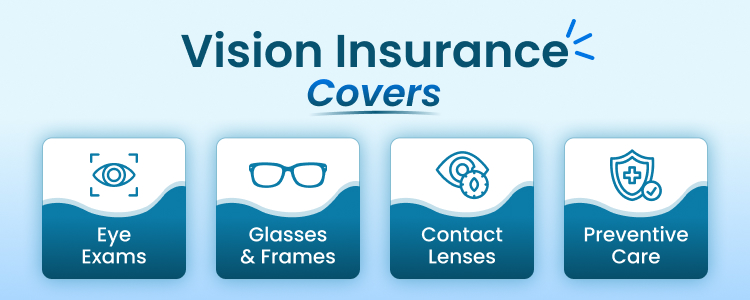
Vision insurance coverage varies by plan and provider, but most affordable vision insurance plans follow a consistent structure. Understanding what is included and what is not helps you evaluate whether a plan’s benefits are actually useful, given how you use eye care.
Eye Exams
Nearly all vision plans cover one comprehensive eye exam per year, sometimes referred to as a routine or wellness exam. This visit checks your vision prescription, tests eye muscle function, and screens for early signs of conditions like glaucoma, cataracts, and macular degeneration. With insurance, most policyholders pay only a small copay of $10 to $30 for this exam, compared to $100 to $250 without coverage. Some plans allow an exam every 12 months; others use a calendar-year basis, resetting each January.
Glasses and Frames
Vision insurance coverage for glasses typically includes a frame allowance, a set dollar amount (commonly $100 to $200) applied toward the cost of a frame at an in-network provider. Basic lens types such as single-vision, bifocal, and trifocal are usually covered in full or at a low copay after the allowance is applied. Premium upgrades, such as anti-reflective coatings, progressive lenses, photochromic lenses, or high-index materials, often come with additional out-of-pocket costs. Understanding exactly what your plan’s frame and lens benefits include is essential before selecting a plan.
Contact Lenses
Most plans offer an annual allowance for contact lenses instead of glasses, typically ranging from $100 to $200 per year. Some plans offer a flat discount on contacts rather than a fixed allowance. Specialty contacts toric lenses for astigmatism or multifocal contacts may have limited coverage or require a higher out-of-pocket contribution. If you wear contacts regularly, comparing the contact lens benefit is one of the most important factors when choosing between plans.
Preventive Eye Care
One underappreciated vision health insurance benefit is its role in early disease detection. Routine eye exams do more than measure your prescription. Eye doctors routinely screen for high blood pressure, diabetes indicators, and neurological conditions during a standard exam. Catching these early can reduce long-term treatment costs significantly. Vision insurance encourages annual visits that many people would otherwise skip due to cost, which makes it a genuinely preventive health tool, not just an eyewear discount program.
How Much Does Vision Health Insurance Cost?
The vision insurance cost you pay depends on whether you are enrolled through an employer group plan or purchasing coverage individually on the open market. Group plans offered through employers tend to have lower premiums because the cost is spread across many enrollees. Individual plans purchased directly through insurers or exchanges typically cost more.
Most individual vision insurance plans range from $5 to $25 per month for basic coverage, or $60 to $300 per year. Family plans typically run $20 to $50 per month. Employer-sponsored vision benefits are often subsidized, and employees may pay as little as $2 to $10 per month through payroll deduction.
Factors that affect pricing include your age, whether the plan covers one person or a family, the generosity of frame and contact allowances, and the size of the provider network. Premium-tier plans with higher allowances and more covered lens options naturally cost more than bare-bones plans.
Average Cost Breakdown
Understanding what you would pay with and without vision insurance helps clarify whether the math works in your favor. The table below reflects typical costs in the United States as of 2026:
| Service | Without Insurance | With Insurance |
| Eye Exam | $100 – $250 | $10 – $30 copay |
| Frames | $100 – $400+ | $0 – $50 after allowance |
| Single-Vision Lenses | $50 – $200 | $0 – $75 after coverage |
| Contact Lenses (annual) | $200 – $400 | $100 – $200 after allowance |
| Total Estimated Cost | $450 – $1,250+ | $110 – $355 |
For someone who wears prescription glasses and gets an annual exam, the annual savings from a $120-per-year vision plan can range from $200 to $600, depending on the frames and lenses chosen. That is a meaningful return on a modest premium investment.
Is Vision Health Insurance Worth It?
The honest answer is: it depends on your individual usage and vision care needs. Vision insurance delivers genuine value for people who use their benefits consistently. For those with minimal eye care needs, it can be an unnecessary expense. The key is to calculate the math based on your actual expected usage.
When Vision Insurance Is Worth It
Vision insurance tends to be a smart financial decision in the following situations:
- You get regular eye exams every year. The exam benefit alone often covers a significant portion of the annual premium cost.
- You wear prescription glasses or contact lenses, the frame allowance and contact lens benefit can produce $100 to $300 in savings annually.
- You have children who often need updated prescriptions more frequently, and covering multiple family members under a group plan multiplies the savings.
- You have predictable yearly usage. People who know they will use the exam and eyewear benefits every 12 months can budget for it reliably and maximize the annual benefit.
- You are a heavy screen user. Digital eye strain increases the value of regular exams, and many people in desk-based or remote work roles benefit from annual checkups and updated prescriptions.
When It May Not Be Worth It
There are legitimate scenarios where skipping vision insurance and paying out-of-pocket is the more economical choice:
- You rarely need vision care if you have excellent natural vision and skip eye exams for several years, the premiums you pay will likely exceed the cost of an occasional out-of-pocket visit.
- Your prescription is stable if your prescription has not changed in years, and you do not need new glasses or contacts, the annual savings may not justify the premium.
- You have access to an FSA or HSA flexible spending account and health savings accounts, which allow you to pay for eye exams and glasses with pre-tax dollars, partially replicating the savings effect of vision insurance without a separate premium.
Quick Tip: Run the numbers before deciding. Add up your expected annual spending on eye exams, glasses, and contacts. If that total exceeds your annual premium by a meaningful margin, vision coverage is likely worth it for you.
Vision Insurance vs Paying Out-of-Pocket
| Factor | Vision Insurance | Paying Out-of-Pocket |
| Annual Cost Example | ~$180/year premium + low copays | ~$300–$600/year for exam + glasses |
| Typical Savings | Saves ~$120–$420 annually | No savings, full cost paid |
| Upfront Cost | Monthly premium (fixed) | Pay only when needed |
| Exam Cost | ~$20 copay | Full price (~$100–$200) |
| Glasses Cost | Covered partially (e.g., $200 allowance) | Full price (~$200–$400+) |
| Cost Predictability | High (fixed yearly cost) | Low (varies per need) |
| Flexibility | Limited to network providers | Full freedom (online & offline options) |
| Best For | Regular users (yearly exams, glasses) | Occasional users with minimal needs |
| Financial Risk | Lower (shared with insurer) | Higher (you pay everything) |
Vision Insurance vs Discount Vision Plans
| Factor | Vision Insurance | Discount Vision Plan |
| Payment Type | Monthly premium | Annual membership fee ($75–$150) |
| How It Works | The insurer pays part of the costs | You get discounted rates only |
| Coverage | Includes exams, glasses, and contacts | No coverage, only discounts |
| Allowances | Yes (frames, contacts) | No allowances |
| Claims Process | May involve claims or copays | No claims required |
| Savings Type | Structured benefits + cost sharing | Flat discounts at providers |
| Financial Risk | Shared with insurer | Fully yours |
| Best For | Frequent users needing regular care | Occasional users wanting basic savings |
| Overall Value | Higher for regular usage | Better for light or infrequent usage |
How to Choose the Right Vision Health Insurance Plan
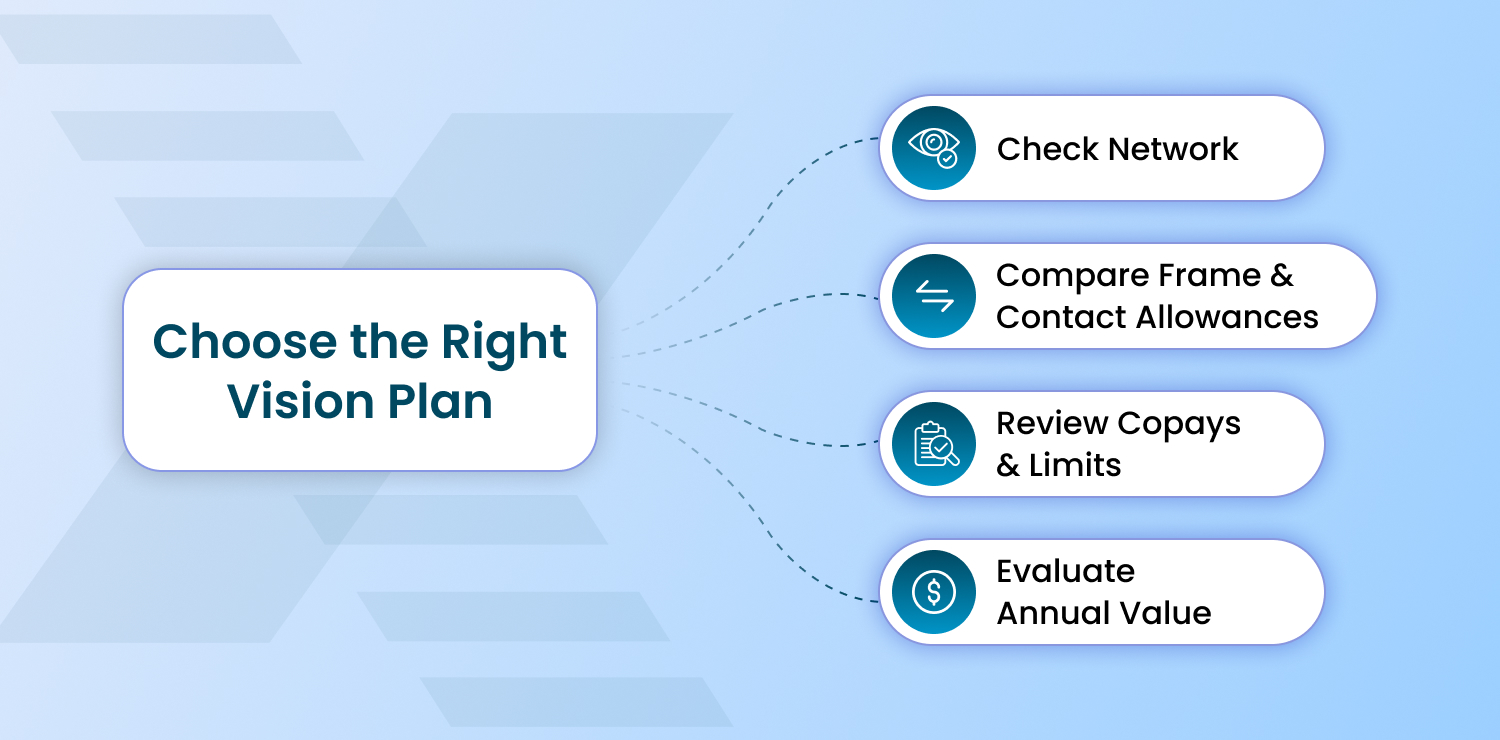
With dozens of affordable vision insurance plans available through employers, insurers, and the individual market, finding the right one requires a structured comparison. Here are the key factors to evaluate:
Check Provider Network
Start by confirming that your preferred eye doctor is in-network under any plan you are considering. Using an out-of-network provider significantly reduces your benefit or eliminates it. Major vision networks include VSP, EyeMed, Spectera, Davis Vision, and Superior Vision. A plan with a wide local network reduces the friction of using your benefits each year.
Compare Allowances (Frames & Contacts)
The frame allowance and contact lens allowance are among the most impactful variables when comparing plans. A plan with a $200 frame allowance will save you considerably more than one with a $100 allowance if you tend to buy mid-range or premium frames. Similarly, if you wear contacts, look for plans with a $150 or higher annual contact lens allowance to maximize savings.
Understand Copays and Limits
Some plans charge copays for exams, lens upgrades, or contact lens fittings. Others apply waiting periods before certain benefits kick in. Read the fine print on what is covered at a copay versus what requires full out-of-pocket payment after the allowance is exhausted. Cheap vision insurance with low premiums sometimes comes with higher copays or lower allowances that offset the savings.
Review Total Annual Value
Before committing, calculate the plan’s total annual value against its cost. Add the expected exam savings, frame allowance, and contact benefit. Subtract the annual premium. If the net savings are positive, especially if they are $100 or more, the plan likely makes financial sense for your usage pattern. If the math is close to break-even, consider whether the predictability and convenience of insurance still add value for you personally.
Who Should Consider Vision Insurance?
Not everyone has the same vision care needs, and vision insurance value varies considerably across different life stages and usage profiles. The following groups tend to benefit most:
- Individuals with frequent prescription updates, anyone who needs a new prescription annually or every other year, will consistently use their exam and eyewear benefits, generating reliable savings.
- Families with children, kids’ eyes change rapidly, meaning multiple family members may each need exams and updated prescriptions within a given year. Family vision plans with low per-person costs often deliver outsized value for households with two or more children.
- Screen-heavy workers, remote workers, software developers, designers, writers, and others who spend eight or more hours per day in front of screens are at heightened risk for digital eye strain and myopia progression. Annual exams and updated prescriptions are not optional expenses for this group; they are a workplace necessity.
- Older adults, people over 40, often experience accelerated vision changes, increasing the frequency of prescription updates and the likelihood of conditions like presbyopia. Regular exams also become more critical for early detection of age-related eye conditions such as glaucoma, macular degeneration, and cataracts.
Ways to Save Money on Vision Care
Whether or not you have vision insurance, there are practical strategies to reduce your overall eye care expenses:
- Use in-network providers consistently; staying within your plan’s provider network is the single most effective way to maximize your vision insurance benefits. Out-of-network visits often come with dramatically reduced or zero coverage.
- Maximize annual benefits before they expire. Most vision plans reset on a calendar or policy-year basis. If you have unused frame or contact allowances, schedule your annual exam and purchase eyewear before the reset date. Unused benefits do not roll over.
- Combine insurance with additional discounts; many in-network optical retailers offer additional promotions on top of your insurance allowance. It is worth asking about current promotions, second-pair discounts, or package deals when purchasing frames and lenses.
- Shop online for contacts with your prescription after receiving your prescription from a covered in-network visit. Purchasing contact lenses from reputable online retailers is often significantly cheaper than buying at the optical shop. Some plans even offer mail-order discounts.
- Use an FSA or HSA to cover uncovered costs, and any vision care expenses not covered by your plan, such as premium lens upgrades or out-of-network visits, can be paid with pre-tax FSA or HSA dollars, reducing the effective cost by your marginal tax rate.
Common Mistakes to Avoid
People often leave money on the table or overpay for vision coverage because of a few recurring errors. Here is what to watch out for:
- Ignoring plan limits, every vision plan has annual maximums, frequency limits, and exclusions. Assuming you are covered without reading the details leads to unpleasant billing surprises. Review coverage summaries carefully before enrollment.
- Choosing based only on the premium, the cheapest monthly premium does not always mean the best value. A plan with a lower premium but a $75 frame allowance may save you far less than a plan at $5 more per month with a $175 allowance. Evaluate total annual value, not just the sticker price.
- Not checking coverage details for your specific eyewear needs if you wear progressive lenses, specialty contacts, or high-index materials, confirm that your plan covers these specifically. Some plans cover only basic lenses and require large out-of-pocket payments for premium options.
- Forgetting to use benefits before they expire is one of the most common and costly mistakes. Set a calendar reminder each year to schedule your eye exam and use your allowance before the benefit year ends.
FAQs About Vision Insurance
1. What is vision insurance, and how does it work?
Vision insurance is a type of coverage that helps pay for eye care services like eye exams, glasses, and contact lenses. You typically pay a monthly premium and receive benefits such as copays and allowances for eyewear.
2. What does vision health insurance usually cover?
Most vision insurance plans cover routine eye exams, glasses frames, lenses, and contact lenses. Some plans also include discounts on lens upgrades and preventive eye care services.
3. Is vision insurance worth it for people who wear glasses or contacts?
Yes, vision insurance is usually worth it for people who regularly need glasses or contact lenses, as it helps reduce the overall cost and provides predictable yearly coverage.
4. Can vision insurance be used without health insurance?
Yes, vision insurance is separate from health insurance. You can purchase and use it on its own for routine eye care and eyewear needs.
5. How often can you use vision insurance benefits?
Most plans allow you to use benefits once every 12 months for eye exams and either glasses or contact lenses, depending on the plan details.
6. Does vision insurance cover both glasses and contact lenses?
Many plans allow you to choose between glasses or contact lenses within the same benefit period. Some may offer partial benefits for both, but it depends on the plan.
7. Are there network restrictions with vision insurance?
Yes, most vision insurance plans require you to visit in-network providers to get the full benefits. Out-of-network visits may still be covered, but usually at a lower reimbursement level.
8. What is the difference between vision insurance and a vision discount plan?
Vision insurance provides structured benefits like exam coverage and allowances for eyewear. Discount plans only offer reduced prices at participating providers without actual coverage.
9. Who should consider getting vision insurance?
Vision insurance is a good option for individuals who need regular eye exams, wear corrective lenses, have families, or want predictable eye care expenses.
10. Can vision insurance help with the early detection of eye problems?
Yes, routine eye exams covered by vision insurance can help detect vision issues and early signs of eye conditions, supporting better long-term eye health.
Final Thoughts
So, is vision health insurance worth it? For most people who wear glasses or contacts and get regular eye exams, the answer is a clear yes. The math consistently favors having coverage when you use your benefits annually. A modest premium of $10 to $20 per month can unlock $200 to $500 in annual savings on eye exams, frames, and contact lenses, making it one of the higher-return supplemental insurance products available.
That said, vision insurance is not universally valuable. If you have excellent natural vision, rarely visit an eye doctor, and do not expect significant near-term prescription changes, the premium may outpace your actual savings. In that case, a discount vision plan, an FSA, or simply budgeting for infrequent out-of-pocket costs may be the more efficient path.
The most important thing is to make your decision based on data, not assumptions. Compare your expected annual eye care costs against available plan premiums and allowances. Check your preferred provider network. Evaluate the full scope of vision insurance benefits, not just the monthly cost. When you approach it with that kind of informed comparison mindset, finding the right affordable vision insurance plan becomes straightforward.
About AHiX, consumers navigate health insurance, vision plans, and supplemental coverage with clear, unbiased guides. Explore our full library of insurance resources to make informed decisions about your healthcare spending.