
If you’ve ever stared at a list of health plans and seen four confusing letters HMO, PPO, EPO, POS sitting next to the metal tier (Bronze, Silver, Gold) and price, you’re not alone. Most people assume the metal tier is the only thing that matters. It isn’t. The plan type determines something just as important: which doctors you can see, whether you need a referral, and what happens if you go out-of-network without realizing it.
Choosing between an HMO and a PPO (or an EPO or a POS) is really a trade-off between cost and flexibility. Get it right, and you’ll pay less for coverage that still works the way you live. Get it wrong, and you could end up with a denied claim, a surprise bill, or a plan that doesn’t include your current doctor at all. This guide breaks down exactly how each plan type works, what they cost compared to each other, and how to decide which one fits your situation.
What Do HMO, PPO, EPO, and POS Actually Mean?
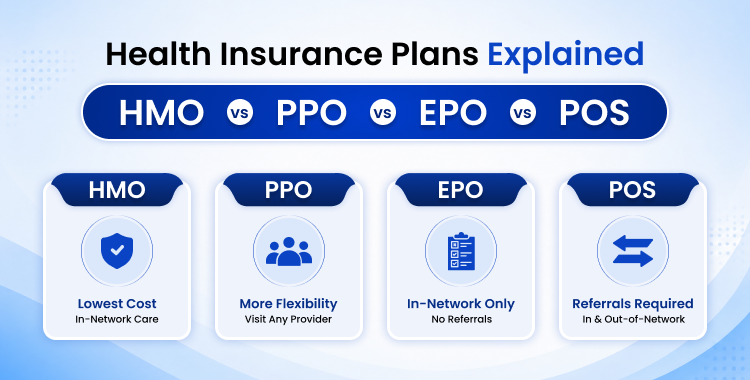
Every health plan you’ll see on a marketplace like Healthcare.gov or through a private exchange falls into one of these four network structures. The letters describe how the insurance company controls access to care in exchange for a lower or higher price.
- HMO Health Maintenance Organization
- PPO Preferred Provider Organization
- EPO Exclusive Provider Organization
- POS Point of Service
They all pay for medical care. The difference is in the rules: which doctors you’re allowed to see, whether you need a primary care physician to manage your care, and whether the plan will pay anything at all if you go outside its network.
HMO: Lowest Cost, Least Flexibility
An HMO health plan is built around a network of doctors and hospitals that agree to lower rates in exchange for a larger volume of patients from the insurer. In return, HMO members get some of the lowest premiums and lowest out-of-pocket costs available on the market.
How an HMO works:
- You choose (or are assigned) a Primary Care Physician (PCP) who manages your care.
- To see a specialist, you typically need a referral from your PCP first.
- Care outside the network is not covered, except in true emergencies.
- Premiums and copays are usually the lowest of the four plan types.
Who an HMO makes sense for: People who have a regular doctor they’re happy with (or don’t mind picking one), don’t travel often, and want to minimize monthly costs. HMOs also tend to work well for young, healthy individuals and families who see the doctor infrequently and mostly need affordable preventive care. If you’re weighing this against a Bronze plan specifically to cut your premium, an HMO structure on top of that tier often produces the cheapest monthly bill on the exchange.
Where an HMO falls short: If your doctor isn’t in the network, you’ll have to switch. If you need to see a specialist for anything beyond routine care, you’ll be waiting on a referral. And if you travel frequently or split time between two states, an HMO can leave you with no coverage away from home except for emergencies.
PPO: Higher Cost, Maximum Flexibility
A PPO is the plan type most people default to when they want freedom of choice. It still has a network of “preferred” providers who offer discounted rates, but it doesn’t restrict you to that network the way an HMO does.
How a PPO works:
- No requirement to choose a Primary Care Physician.
- No referral needed to see a specialist.
- You can see out-of-network providers; you’ll just pay more out of pocket for it.
- Premiums and deductibles are typically higher than HMOs, EPOs, or POS plans.
Who a PPO makes sense for: Anyone who wants to keep an existing doctor who may not be in-network, sees multiple specialists, has a chronic condition requiring coordinated care across providers, or travels enough that having flexibility outside a narrow network matters. Families managing several people’s care kids’ pediatricians, an OB-GYN, a specialist for an aging parent often find the PPO’s lack of referral requirements worth the extra premium.
Where a PPO falls short: You’ll pay for that flexibility. Monthly premiums run noticeably higher, and deductibles can be steep before the plan starts paying its share. If cost is your primary concern, for example, if you’re already looking at ways to handle a premium increase, a PPO is usually not the cheapest way to solve that problem.
EPO: A Middle Ground With a Catch
An EPO combines pieces of both. Like a PPO, it doesn’t require a referral to see a specialist. Like an HMO, it won’t pay for care outside its network except in emergencies.
How an EPO works:
- No referral required for specialists.
- No coverage for out-of-network care (non-emergency).
- No requirement to designate a Primary Care Physician in most EPO plans.
- Premiums generally fall between HMO and PPO pricing.
Who an EPO makes sense for: People who want the freedom to self-refer to specialists without going through a gatekeeper PCP, but who are also comfortable staying within a defined network and don’t need out-of-network coverage. EPOs have become one of the fastest-growing plan types on ACA marketplaces because they let insurers offer PPO-like flexibility at closer to HMO-like pricing.
Where an EPO falls short: The lack of out-of-network coverage is absolute. If you get sick while traveling and need non-emergency care, or your specialist of choice isn’t in the network, you’re paying full price with no plan assistance. It’s worth double-checking network size before enrolling; some EPO networks are surprisingly narrow.
POS: A Hybrid, But Less Common
A Point of Service plan borrows the PCP-and-referral structure from HMOs and combines it with limited out-of-network coverage similar to a PPO.
How a POS plan works:
- You choose a Primary Care Physician.
- Referrals are typically required to see specialists.
- Out-of-network care is covered, but at a significantly higher cost-share than in-network care.
- Premiums often land in the middle of the range, similar to EPOs.
Who a POS plan makes sense for: People who want the lower costs associated with PCP-managed care but also want some safety net if they need to go outside the network occasionally, for instance, a specialist near a second home, or a provider recommended by family who happens to be out-of-network.
Where a POS plan falls short: POS plans are less common on ACA marketplaces than they used to be, and the paperwork burden (referrals, claims for out-of-network visits) is heavier than an EPO or PPO. For many shoppers, it ends up being the least straightforward of the four options.
HMO vs PPO vs EPO vs POS: Quick Comparison
| Feature | HMO | EPO | POS | PPO |
| Monthly premium | Lowest | Low–Moderate | Moderate | Highest |
| Primary Care Physician required | Yes | Usually no | Yes | No |
| Referral needed for specialists | Yes | No | Yes | No |
| Out-of-network coverage | No (emergencies only) | No (emergencies only) | Yes, at higher cost | Yes, at higher cost |
| Best for | Lowest cost, simple care needs | Flexibility without high premiums | Some out-of-network safety net | Maximum choice and flexibility |
PPO vs HMO Cost: What’s the Real Difference?

This is the comparison most people actually search for, so it’s worth being direct about it. On average, HMO premiums are 10–20% lower than PPO premiums for a comparable metal tier, and HMO deductibles are often lower as well, since insurers manage risk more tightly through the referral system.
That gap can matter enormously depending on your health situation. A healthy individual who rarely visits a specialist may save several hundred dollars a year on an HMO with almost no downside. Someone managing a chronic illness who sees three or four specialists regularly may find that the PPO’s higher premium is offset by not having to chase referrals or worry about network gaps and by having access to specialists an HMO network might not include at all.
The honest answer to “which is cheaper” is: HMO is cheaper month-to-month, but a PPO can be cheaper overall if it prevents you from paying full price out-of-network for care an HMO simply wouldn’t cover.
How to Decide: 5 Questions to Ask Before You Choose
- Do I have a doctor I want to keep? Check whether they’re in-network before you pick a plan type, not after.
- How often do I see specialists? Frequent specialist visits favor a PPO or EPO over an HMO.
- Do I travel often or split time between states? If yes, an HMO’s lack of out-of-network coverage could leave real gaps. This matters even more if you’re moving to a new state and need to know how your coverage will translate.
- Am I price-sensitive month-to-month, or do I want to minimize worst-case cost? HMOs win on predictable monthly savings; PPOs win on flexibility if something unexpected happens.
- Do I mind managing referrals? If the idea of calling your PCP before every specialist visit sounds like a hassle, cross HMO and POS plans off your list.
Plan Type Isn’t the Only Decision
Plan type works alongside, not instead of, the metal tier you choose. A Bronze HMO and a Gold PPO can have wildly different total costs even though they’re both technically “insurance.” If you haven’t already compared how Bronze, Silver, Gold and Platinum tiers affect your deductible and coinsurance, it’s worth reading alongside this guide before you enroll.
If you’re weighing coverage options as a small business owner deciding what to offer employees, plan type selection gets even more important, since a narrow HMO network might not suit every employee’s existing doctor relationships something covered in more depth in our small business health insurance guide. And if you’re self-employed or a 1099 contractor comparing marketplace options on your own, understanding plan type is one of the fastest ways to bring your premium down without sacrificing coverage you actually need; see our full breakdown for self-employed and 1099 workers.
If cost is the deciding factor and you’re trying to bring your monthly bill down after this year’s premium hikes, switching from a PPO to an EPO or HMO while keeping the same metal tier is one of the more effective ways to cut costs without dropping down to a plan with a much higher deductible. For more on managing rising costs directly, see what to do about 2026’s premium increases.
Ready to Compare Plans Side by Side?
Plan type, metal tier, deductible, and network size all interact to determine your real cost of care, not just your monthly premium. Rather than guessing, see the plans available in your area and compare HMO, PPO, EPO, and POS options side by side based on your ZIP code, household size, and income.
Frequently Asked Questions
1. What’s the main difference between an HMO and a PPO?
An HMO requires you to use in-network providers and get referrals to see specialists, with lower premiums in exchange. A PPO lets you see any provider, in or out of network, without a referral, but at a higher premium.
2. Is an EPO better than an HMO?
It depends on your priorities. An EPO usually skips the referral requirement that HMOs have, giving you more freedom to see specialists directly, but it still won’t cover non-emergency out-of-network care, just like an HMO.
3. Can I see an out-of-network doctor with a PPO?
Yes. A PPO covers out-of-network care, though you’ll pay a larger share of the cost than you would for an in-network provider.
4. Does a POS plan require a referral?
Most POS plans require you to choose a Primary Care Physician and get a referral before seeing a specialist, similar to an HMO, but they also offer limited out-of-network coverage similar to a PPO.
5. Which plan type is cheapest?
HMOs typically have the lowest monthly premiums and lowest out-of-pocket costs of the four plan types, because insurers manage costs tightly through referrals and a defined network.
6. Which plan type gives the most flexibility?
A PPO offers the most flexibility, since it doesn’t require referrals and still provides (partial) coverage for out-of-network care.
7. Can I switch plan types after I enroll?
Generally, no you’re locked into your plan type and tier until the next Open Enrollment Period or unless you qualify for a Special Enrollment Period due to a qualifying life event.
8. Do all insurance companies offer all four plan types?
No. Availability varies by state, county, and carrier. Some regions may only offer HMO and PPO options, while EPOs and POS plans are less universally available.
9. Is an HMO a bad choice if I have a chronic condition?
Not necessarily, as long as your specialists are in-network and you’re comfortable with the referral process. If your specialists are spread across multiple networks, though, a PPO or EPO may serve you better.
10. How do I know which plan type my current doctor accepts?
Check the insurer’s provider directory before enrolling, or call your doctor’s office directly and ask which specific plans (not just which insurance companies) they’re in-network for, since network participation can vary by plan type even within the same carrier.