
Moving to a new country brings enough uncertainty without having to worry about what happens if you or a family member gets sick. Yet for many immigrants living in the United States, understanding health coverage options is one of the most confusing parts of settling in. Immigration status, income, employment, and even how long you have lived in the country all play a role in what type of plan you can enroll in and how much you will pay for it.
This guide walks through the coverage options available to immigrants in the U.S., explains how status affects eligibility, and offers practical steps for finding a plan that fits your budget and health needs.
Why Health Insurance Matters for Immigrants
Healthcare in the U.S. is expensive, and a single emergency room visit or hospital stay can cost thousands of dollars without coverage. For newcomers who are still building credit, savings, or a support system in a new country, an unexpected medical bill can be financially devastating.
Health insurance also gives you access to preventive care, routine checkups, and prescription medication, all of which help you stay healthy and avoid costly complications down the road. Many employers, schools, and visa sponsors also require proof of coverage, making insurance a practical necessity rather than an optional expense.
How Immigration Status Affects Your Coverage Options
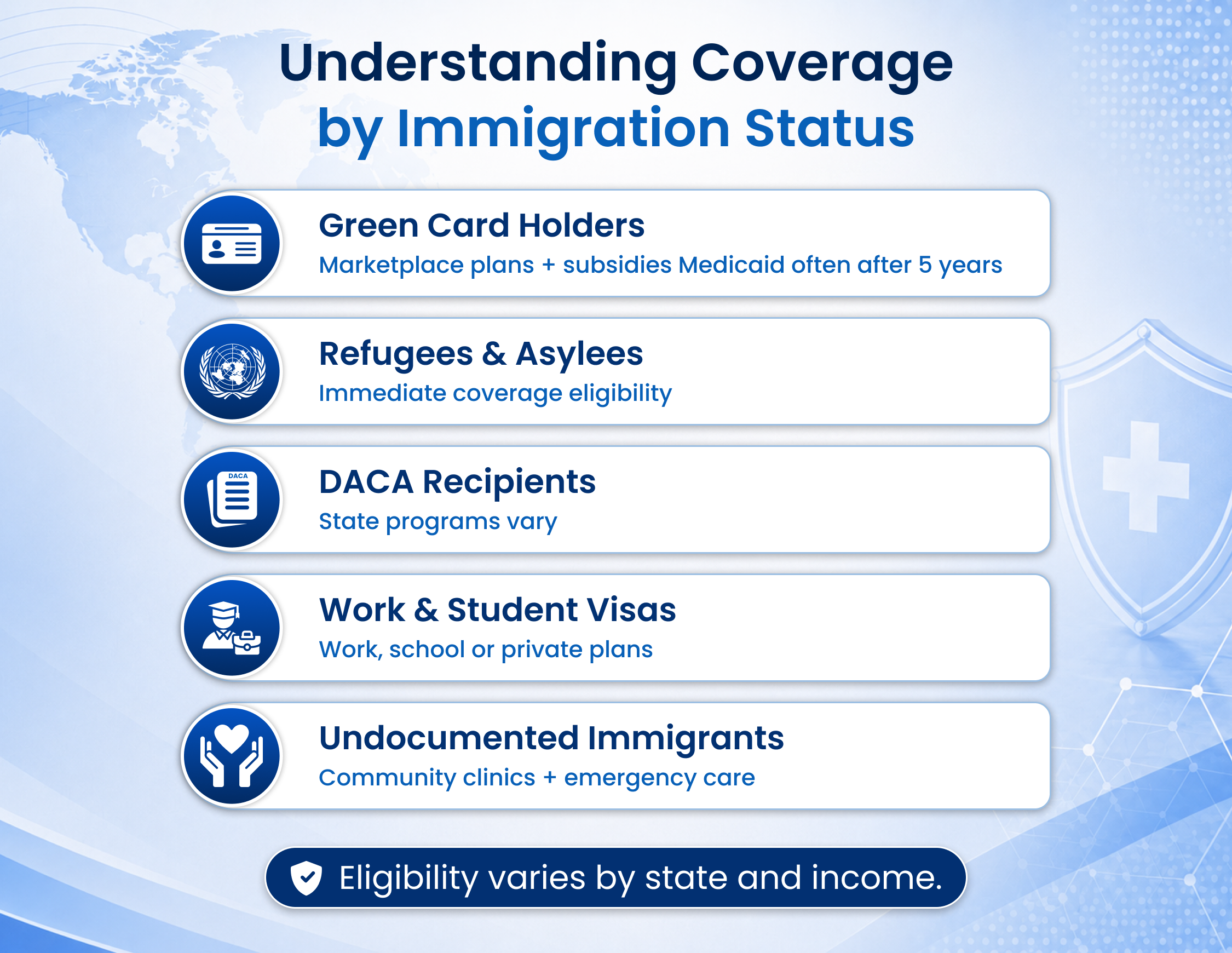
Not every immigrant qualifies for the same programs. Eligibility generally depends on your immigration category and how long you have held that status.
Lawful Permanent Residents (Green Card Holders)
Green card holders are generally eligible to purchase plans through the ACA Health Insurance Marketplace and may qualify for premium subsidies based on income. However, most green card holders must wait five years after receiving their status before they can enroll in full Medicaid benefits, a rule commonly known as the five-year bar. Some states have expanded eligibility for children and pregnant women regardless of this waiting period.
Refugees and Asylees
Refugees, asylees, and certain humanitarian entrants are treated differently from other immigrants. They are typically eligible for Medicaid or the Refugee Medical Assistance program immediately upon arrival, without the five-year waiting period that applies to other lawfully present immigrants.
DACA Recipients
Coverage rules for DACA recipients have changed multiple times in recent years and vary by state. Some states allow DACA recipients to purchase Marketplace plans or qualify for state-funded Medicaid programs, while others do not. It is worth checking current state-specific rules before assuming eligibility.
Work Visa and Student Visa Holders
Individuals on work visas such as H1B or L1, and international students on F1 visas, are usually not eligible for ACA Marketplace subsidies or Medicaid. Most rely on employer-sponsored insurance, university health plans, or private and short-term insurance options purchased independently.
Undocumented Immigrants
Undocumented immigrants generally cannot enroll in ACA Marketplace plans, Medicaid, or Medicare. Coverage options in this situation are more limited and typically include employer-sponsored plans (if offered), community health centers, sliding-scale clinics, and private insurance purchased directly from an insurer.
Coverage Options Available to Immigrants
ACA Marketplace Plans
For immigrants who are lawfully present in the U.S., the ACA Marketplace is often the most comprehensive coverage option. Plans cover pre-existing conditions from day one and include essential benefits like hospitalization, prescription drugs, maternity care, and preventive services. Depending on income, many applicants also qualify for subsidies that lower monthly premiums significantly. You can compare affordable individual health insurance plans to see what is available in your state and income bracket.
Qualified Health Plans (QHP)
Qualified Health Plans are ACA-compliant plans certified to meet minimum essential coverage standards. These plans follow strict rules on cost sharing limits and must offer the same core set of benefits regardless of the insurer. If you want a deeper explanation of what makes a plan “qualified” and how it differs from non-qualified coverage, this breakdown of qualified health plans covers the details.
Medicaid and CHIP
Medicaid and the Children’s Health Insurance Program (CHIP) provide low-cost or free coverage to eligible low-income individuals and families. Eligibility for lawfully present immigrants depends on status, state of residence, and how long the person has held that status. Some states use their own funds to cover children and pregnant women regardless of the standard waiting period, so it is worth checking local program rules directly.
Employer-Sponsored Insurance
If you are employed full-time, ask your employer whether health benefits are offered. Employer-sponsored plans are often the most cost-effective option since employers typically cover a portion of the premium. This applies to many work visa holders as well as green card holders and citizens.
Short-Term Health Insurance
Short-term plans can be a practical bridge for immigrants who are between jobs, waiting for a visa-related benefit to start, or who missed the ACA Open Enrollment window. These plans are approved quickly and provide temporary protection against major medical expenses, though they typically do not cover pre-existing conditions or the full list of essential benefits. Learn more about how short-term health insurance works and whether it fits your timeline.
Community Health Centers and Free Clinics
Federally funded community health centers provide primary care, dental, and mental health services on a sliding fee scale based on income, regardless of immigration status or insurance coverage. These centers can be an important safety net for individuals who do not currently qualify for any insurance program.
Private and International Insurance
Some immigrants, particularly those on temporary visas, choose to purchase private insurance directly from an insurer rather than going through the ACA Marketplace. International student and visitor insurance plans are also available and are sometimes required by universities or visa sponsors as a condition of enrollment or entry.
Understanding the Public Charge Consideration
Many immigrants worry that using public benefits like Medicaid could affect their immigration status or future green card or citizenship applications, a concept known as the public charge rule. Policy details around public charge have changed over time and can be complex, so it is best to consult an immigration attorney or accredited representative before declining coverage out of concern for this issue. Generally, purchasing a Marketplace plan with subsidies has not been treated the same way as long-term reliance on cash assistance programs.
Tips for Choosing the Right Plan
- Check your eligibility first. Your immigration status and how long you have held it will narrow down your realistic options.
- Compare premiums against your budget. A lower premium is not always the better deal if the deductible or out-of-pocket maximum is high.
- Look at the provider network. Make sure the doctors, specialists, and hospitals you may need are included.
- Factor in prescription coverage. If you or a family member takes regular medication, confirm the plan includes it in its formulary.
- Consider your family’s needs. Families with children may want to explore family health insurance plans that cover everyone under one policy.
- Watch enrollment deadlines. ACA Marketplace plans generally require enrollment during Open Enrollment unless you qualify for a Special Enrollment Period due to a qualifying life event such as a status change, marriage, or the birth of a child.
If you are unsure where to start, this guide on affordable health insurance options breaks down how to compare plans based on your budget and lifestyle, and this life situation guide can help you find the coverage path that matches where you currently stand.
Steps to Get Covered
- Confirm your immigration status and how it affects eligibility for Marketplace, Medicaid, or employer coverage.
- Gather documentation such as your visa, green card, or work authorization along with proof of income.
- Compare available plans based on premium, coverage, and network.
- Apply through the ACA Marketplace, your state Medicaid office, your employer’s benefits portal, or directly through a private insurer.
- Review your plan annually, since income, family size, and immigration status can change your eligibility for subsidies or programs over time.
Final Thoughts
Health insurance for immigrants is not a one-size-fits-all process, but there is almost always a path to coverage once you understand how your status affects eligibility. Whether that means enrolling in a subsidized Marketplace plan, applying for Medicaid, relying on employer benefits, or bridging a gap with short-term insurance, taking the time to understand your options now can save you significant stress and money later. AHiX Marketplace makes it easier to compare plans side by side so you can find coverage that genuinely fits your situation.
Frequently Asked Questions
Can immigrants buy health insurance through the ACA Marketplace?
Yes. Lawfully present immigrants can generally purchase health insurance through the ACA Marketplace. Depending on their household income and family size, they may also qualify for premium tax credits or other savings.
Can immigrants qualify for Marketplace health insurance subsidies?
Yes. Lawfully present immigrants may qualify for premium tax credits based on their estimated annual household income, family size, and other eligibility requirements. Subsidies are available only when coverage is purchased through the Marketplace.
Do green card holders have to wait to get Medicaid?
Many green card holders are subject to a five-year waiting period before they can qualify for federally funded Medicaid or CHIP. However, exceptions may apply, and some states provide coverage without the waiting period for lawfully residing children and pregnant women.
Are undocumented immigrants eligible for health coverage?
Undocumented immigrants cannot enroll in ACA Marketplace coverage. However, they may be able to receive care through community health centers, state-funded programs, sliding-scale clinics or private coverage available outside the Marketplace. Eligibility and available programs vary by state.
Can undocumented immigrants receive emergency Medicaid?
Emergency Medicaid may cover treatment for an emergency medical condition when the individual meets the state’s other Medicaid requirements, such as income and residency rules, but does not have an eligible immigration status. Coverage is generally limited to qualifying emergency services.
Will using Medicaid affect my green card application?
In general, applying for or receiving Medicaid, CHIP, or Marketplace savings does not make someone a public charge. An important exception may apply to long-term institutional care paid for by the government. Because immigration cases vary, anyone with specific concerns should consult a qualified immigration attorney.
What is the fastest way to get temporary health coverage?
The fastest option depends on your immigration status, state, and personal circumstances. A lawfully present immigrant who recently moved to the United States or gained an eligible status may qualify for a Special Enrollment Period.
Short-term insurance may also be available in some states, but it is not ACA-compliant and may exclude pre-existing conditions or essential health benefits. Availability, approval time, and coverage duration vary by state and insurer.
Can international students get health insurance in the U.S.?
Yes. International students with valid non-immigrant status, including eligible student visas, may qualify as lawfully present and purchase Marketplace insurance. They may also be eligible for a university-sponsored student health plan or private insurance, depending on their school’s requirements.
What documents do immigrants need to apply for Marketplace coverage?
Required documents depend on the applicant’s immigration status. Common documents include a Green Card, Employment Authorization Document, foreign passport, I-94 arrival record, immigrant visa, or Form I-20 for eligible students. The Marketplace may request additional documents to verify eligibility.
Can mixed-status families apply for health insurance?
Yes. A mixed-status family can apply for Marketplace, Medicaid or CHIP coverage for eligible family members. Family members who are not applying for coverage for themselves are not required to provide their immigration status.
Can immigrants enroll outside the Open Enrollment Period?
Yes, in certain situations. Moving to the United States from another country, gaining an eligible immigration status, losing other coverage, getting married or having a baby may qualify someone for a Special Enrollment Period. Most Special Enrollment Periods provide a limited enrollment window, so applying promptly is important.
Is immigration information shared with immigration enforcement?
Marketplace immigration information is used to determine health coverage eligibility and administer insurance affordability programs. Family members who are not applying for coverage do not need to provide their citizenship or immigration status.